
Text on screen:
The PIMCO Tactical Opportunities strategy generated an 8.27%1 net year-to-date return. Can you explain what drove this performance in the first half of 2025?
Footnote
1 Year-to-date performance as at 30 June 2025 (Gross 10.01%) for the Tactical Opportunities Fund (USD) Class K net of fees, expenses and incentive allocation
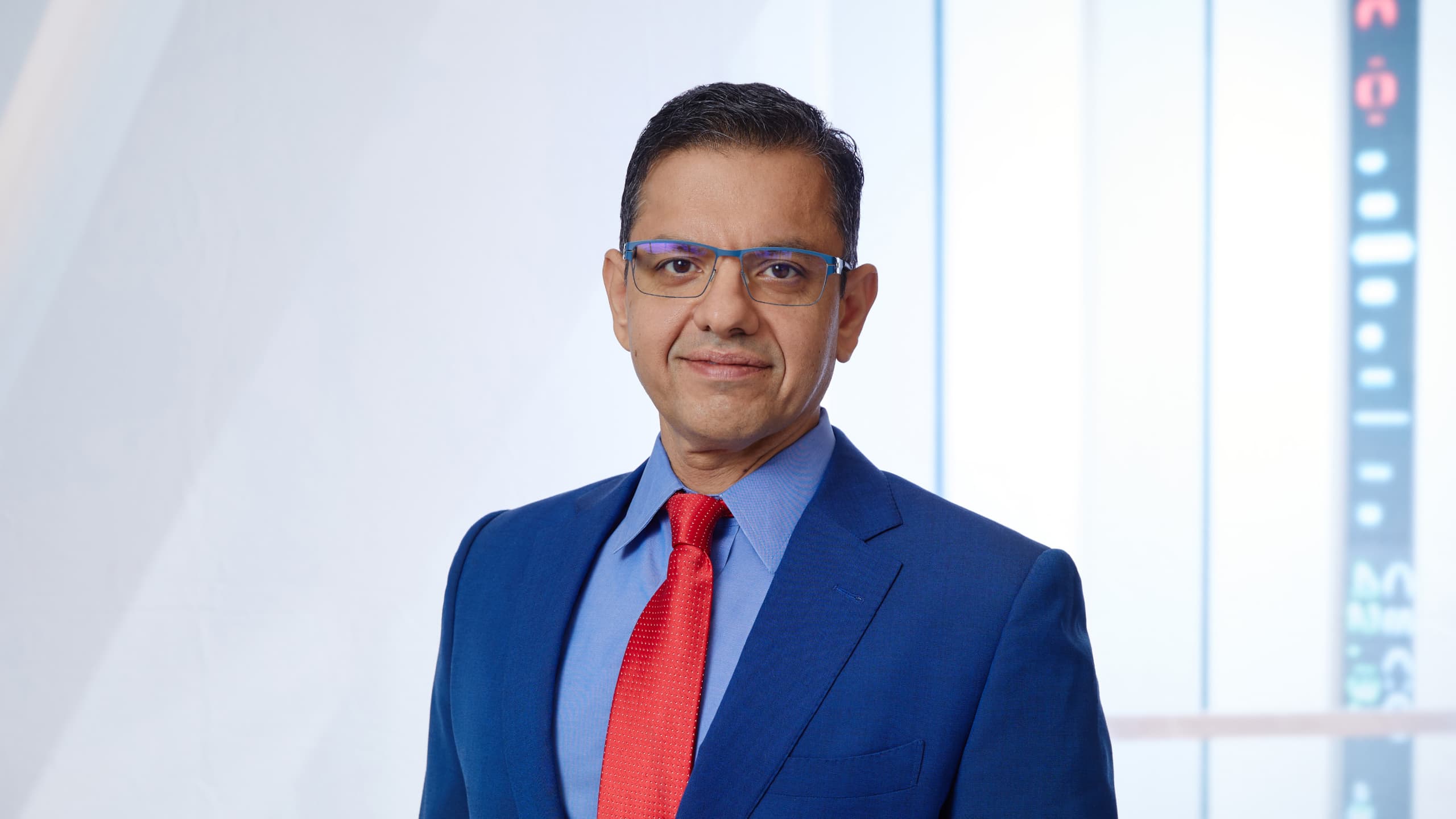
Text on screen: Sharad Bansal, Portfolio Manager, Tactical Opportunities Strategy
So, I would say that this has been a very good start to the year. We're halfway through the year, and one of the interesting things this year, which is basically the core of the fund, is that we are basically getting performance from almost all parts of the portfolio.
We are doing well with our mortgages. We have done well with both commercial and residential real estate. We've done well with our private positions. So this is kind of the year where we feel, like, almost an equal contribution across the portfolio.
And I think one of the big things we've done is we've kind of kept it steady and handled the volatility well. So, I think that's also part of it, because when in April, markets for example, there was a bit of concern in risk assets, and we were able to outperform the market with our hedges. And still able to go offensive when the markets were shy, so I feel keeping the strategy steady has helped quite a bit this year.
Text on screen:
Looking ahead, what are 3 to 5 key factors that support our confidence in the strategy’s ability to continue delivering strong results?
So, we're very excited about Tac Opps’ forward potential, even after what we've seen, the performance this year. I'll highlight a few points. The first, I would say, the yield of the portfolio, even after the performance that we've had, is about 10%. And that's net of hedges.
So, if you compare that to anything in the public markets, that's a very attractive yield. Compared to high yield*, that's almost 40-45% higher in yield.
Footnote * High Yield is represented by the ICE BofA ML High Yield Index
So we think that's very attractive.
Even if you add back the hedging cost, you could start comparing this to, let's say, sectors in the private markets, private credit, it is in par with most private strategies.
The second thing I would say is that we are continuing to find very attractive trades. And our bar is higher, so we are adding trades where we expect to earn a yield basis higher than the portfolio yield of 10%. So, for example, obviously adjusted for quality, we are adding very attractive trades in the 15, 20,12, you know, across the quality spectrum. So that means that you're keeping, keeping and adding more juice to the portfolio, as I would say. So I think that's quite attractive.
If you're looking like we're not staying, you know, completely on the sidelines, we feel there's still very good trades to put on.
Third, I would say, is that the fact that, we have, our focus in Tac Opps is… is finding very unique, idiosyncratic credit profiles in the market, which generally means that we are lowering the beta correlations with your broader markets, like the high-yield market, the bond market in general, the equity market, and you've kind of seen that in the last 12 years of the history of the fund.
And even more recently, in April volatility, where we handled it quite well, the fund did very well in that month. So, I think the fact that you're finding these attractive trades, the yield is very high. And you're adding more trades, and with low beta to the market, I think that's, that's one… at least three reasons, to be optimistic about Tac Opps.
The fourth I would add is that we are in the early stages of a Fed potentially cutting cycle.
If you've been an investor in Tac Opps for a while, I will just reiterate that point, that we don't really try to make money based on big macro moves. Our goal is to basically earn for our investors in all states of the world. But if the Fed does start its interest rate cycle, which the markets are priced for, for example, this year the markets are priced for two cuts from the Fed. And by the end of next year, almost 5 cuts.
If they do materialise, that is a tailwind to the portfolio, because we own lots of mortgage assets. As you know, when interest rates go down, the cost of borrowing for mortgages will go down. And the prepay activity starts, and more refinancing, and generally more movement in the economy. And we're long those assets in a discounted price, so there's a tailwind.
If that doesn't materialise, I don't think that's a headwind either, because, as I mentioned, that's the point of Tac Opps’ portfolio allocation. We want to be winning in most states of the world.
And finally, I would say that our large position that we've had in Venture Global, I feel that we are also getting close to figuring it out and achieving an exit, and where it's priced, we think it's very attractive. So I think all those five things make Tac Opps efficient and an attractive investment opportunity.
Text on screen: What sectors or strategies are you currently targeting for new investments?
I would say, away from that, the new trades that we are putting on in the, for example, the data center space, in the reinsurance market. We feel those can kind of produce very good returns in the space. We have some investments in the defense technology space, which we've received even private bids in the market at much higher than the valuation that we are looking and marking the fund at. So, we feel those are all great, kind of tailwinds to the portfolio.
Text on screen: What other areas of the market currently present opportunities to deploy more capital?
So, I think one of the sectors that we found attractive is in the data center space, as you know, we were a little bit early on that trade before the market caught on with the whole AI, kind of boom that you're seeing across sectors.
So data centers is a space we do find attractive. The key point in data centers for us, which differentiates if you hear it from other people, would be, we're very careful not to get locked into the AI boom cycle, per se, because we want this to be resilient, we want it to work in data centers, even if, like, AI, let's say, loses some of its steam.
So where we are doing data centers is more in Europe, which are geared towards privacy laws in Europe, where countries are really required to have data centers locally in the country. So, we're investing in those kinds of data centers, so we have a good position we are building in Italy, for example.
Where we have secured the land, we have all the permissions, so those are the kind of things we're very excited about in the data center space.
The second space that I would highlight is the reinsurance market in the United States. So, what's happened in the last few years is we've seen inflation in the United States, so the cost of insurance for insurers have generally gone up.
Then we've seen a little bit of the weather-related uncertainty, the storms in Miami, in Florida, in Louisiana, they became more common than not. So, the cost of insurance has generally gone up, so insurers are a little bit hurting, where they're looking for exactly something called a reinsurance risk. So we like that trade because we feel we're getting paid for a distress in a market.
Again, going back to my earlier comment, this is also an investment that doesn't rely on movements in S&P, doesn't where the high-yield market is trading, because it's reinsurance, it's a completely diversified pool of assets. So that's something we've actually done for several years in Tac Opps. It's not a new asset class, but we're re-upping an existing structure that we've invested and had a very good return in.
So I'd say those two are on the more idiosyncratic story trades, but other than that, mortgage assets, you know, the Tac Opps, bread and butter, commercial real estate, residential real estate, asset backed, that's still a very active trade for us. We invest in that space almost on a daily basis.
Text on screen: How should investors think about asset allocation across different asset classes, and where does Tac Opps fit into that?
Sure, that's an excellent question. So, first of all, I would say, my advice would be, it's very difficult to time the markets. You know, you can get, perhaps you can do that a little bit in the equity markets, but even then, it's a difficult space. When you get away from equity markets and into, you're talking about public fixed income, private fixed income, you're talking about private credit, it becomes even harder to time those kinds of markets. So generally, I feel on the public side, the valuations are definitely reaching a little bit on the fuller side of valuation.
For example, investment-grade spreads. They hit a level, that basically we've not seen in 5 years, very recently. So, from Tac Opps’ risk management perspective, what we have started doing is, in the month of April, we were somewhat monetising our hedges, where we started re-adding those hedges back in the portfolio.
Because we feel you're reaching to the point where spreads are generally in the tighter side. So what we do in Tac Opps is essentially very much a relative value cross-sector analysis. We compare what the valuations are in private credit, we compare them to public credit, and then if you feel you're getting paid between the soft arbitrage between those two markets, we invest.
And the one thing I would also advise is, when you look at private credit, private credit is a big world, but it also includes corporate private credit, it also includes asset-backed corporate credit, and Tac Opps differentiates itself. We are mostly focused on the asset-backed part of the private credit market. We're not so much into the corporate side of it. Why? Because we feel, to your earlier point, if you reach a point in the market where there is a re-correction, there is some sort of distress or a recession, you have an asset-backed investment. You can grab those assets. They're worth something. You can value them, you can sell them. But when you're talking about, unsecured kind of, private credit, it's literally, you're talking about nothing to grab. It's just buildings and fixtures and computers. What are you going to do with that?
I would say that you have to be very careful of falling into the time to time the market. The relative value decisions we do across those sectors in the public fixed income, private fixed income, private credit. That's what Tac Opps does on a day-to-day basis, second to second. That's what we do. We're literally selling trades, and I'll talk about some examples where they reach the fuller side, and then we're looking to add back something that's like, hey, this is still underpriced.
Text on screen: What are our current views on Venture Global and what is our exit strategy?
So, Venture Global as you know, all the investors are aware, it's a large position for us. It's large because they've done phenomenally well for our investors, so we have a very high multiple, kind of on it. But obviously it became big, but it became big for a good reason.
So, where we are at with the position, we are extremely focused on finding a good exit for our investors. Where we see the company today, we think it's completely, it's very undervalued still. We are past the lockup, that was in July.
What we are doing besides that, we have also focused on hedging in liquid markets. Not with Venture Global itself, but by other, using other risk factors that can kind of synthetically, I would say, affects this market. So that would include natural gas prices in Europe. Because this company is engaged in selling U.S. natural gas to Europe and Asia, so we have a robust program of hedging and selling natural gas in Europe. We've also used a basket of equivalent companies. Especially those which are, we can proxy as the energy producers or consumers of the world.
We are extremely focused on the strategic side, and where the company sits today, the fundamentals are super solid. The price is volatile, so I, I would definitely, you know, agree on that. It's a lot of volatility, and the best reason that we can come up with why it is so volatile, is the fact that when they went public, they essentially created a very small float.
So, for a company, they just basically create a float of $2 billion, and it's very easy to be technically, you can bounce that around with very little trading volumes, and that's kind of what we're seeing in price action.
So just touching up on the points on exit, we have had a very good exit in another, investment that we've had. We have gotten into the investment, over 3 plus 4 years ago. And we exited in a very attractive IRR. And a $200 million position for Tac Opps. And the only reason I bring it up is the point that, while we may not have the Venture Global exit, but we are getting exits on some other companies, like Just Energy, is an energy retailer which sells energy to customers in Texas. And we got into this trade when there was a big surge in electricity prices in Texas because of a storm, so the company essentially had to sell, and, when the balance sheet got impaired. So, we are getting good exits, and I think Venture Global is definitely on our, super focused for us.
Text on screen: What risks are the team playing close attention to? How are we dealing with those risks?
So I would say, besides typical spread widening and all the other things, we're quite focused on just watching what the tariffs and inflation how that plays out. I think that's something that markets are not really priced for. As you can see, we're still priced for 5-plus cuts, 5 cuts by end of next year, and the inflation, you know, basically, you have a tariff on one side, it has to come out somewhere. Either we see drop in demand from people, they don't want to consume at high prices, or the producers say, I need to pass some cost on.
So we haven't seen that much in data, so I think that's something the Tac Opps team is quite focused on. We are also trying to get ahead of the numbers that are published in the CPI and other data, so look at other alternative kind of sources, where we can come up with a view that, yes, this is coming or not coming, and the markets are fine, because that would be a shock to the market if we actually do see that come back, so you can see a repeat of 2022 where we thought inflation is just not there, and it just kind of comes back. So, I think we are quite focused on that right now.
Disclaimer text on screen
Program recorded 23 August 2025.
All $ amounts referenced are in USD and source citations are PIMCO unless stated otherwise.
The information in this video is for general information only and has been prepared without taking into account the objectives, financial situation or needs of investors. Before making an investment decision investors should obtain professional advice and consider whether the information contained herein is appropriate having regard to their objectives, financial situation and needs.
Investing in the bond market is subject to risks, including market, interest rate, issuer, credit, inflation risk, and liquidity risk. The value of most bonds and bond strategies are impacted by changes in interest rates. Bonds and bond strategies with longer durations tend to be more sensitive and volatile than those with shorter durations; bond prices generally fall as interest rates rise, and the current low interest rate environment increases this risk. Current reductions in bond counterparty capacity may contribute to decreased market liquidity and increased price volatility. Bond investments may be worth more or less than the original cost when redeemed. Commodities contain heightened risk, including market, political, regulatory and natural conditions, and may not be suitable for all investors. Currency rates may fluctuate significantly over short periods of time and may reduce the returns of a portfolio. Derivatives may involve certain costs and risks, such as liquidity, interest rate, market, credit, management and the risk that a position could not be closed when most advantageous. Investing in derivatives could lose more than the amount invested. Equities may decline in value due to both real and perceived general market, economic and industry conditions. Investing in foreign-denominated and/or -domiciled securities may involve heightened risk due to currency fluctuations, and economic and political risks, which may be enhanced in emerging markets. Sovereign securities are generally backed by the issuing government. Obligations of US government agencies and authorities are supported by varying degrees, but are generally not backed by the full faith of the US government. Portfolios that invest in such securities are not guaranteed and will fluctuate in value. High yield, lower-rated securities involve greater risk than higher-rated securities; portfolios that invest in them may be subject to greater levels of credit and liquidity risk than portfolios that do not. Mortgage- and asset-backed securities may be sensitive to changes in interest rates, subject to early repayment risk, and while generally supported by a government, government-agency or private guarantor, there is no assurance that the guarantor will meet its obligations. Income from municipal bonds may be subject to state and local taxes and at times the alternative minimum tax. Swaps are a type of derivative; swaps are increasingly subject to central clearing and exchange-trading. Swaps that are not centrally cleared and exchange-traded may be less liquid than exchange-traded instruments. Inflation-linked bonds (ILBs) issued by a government are fixed income securities whose principal value is periodically adjusted according to the rate of inflation; ILBs decline in value when real interest rates rise. Treasury Inflation-Protected Securities (TIPS) are ILBs issued by the US government. Certain US government securities are backed by the full faith of the government. Obligations of US government agencies and authorities are supported by varying degrees but are generally not backed by the full faith of the US government. Portfolios that invest in such securities are not guaranteed and will fluctuate in value.
This material contains the opinions of the manager and such opinions are subject to change without notice. This material has been distributed for informational purposes only and should not be considered as investment advice or a recommendation of any particular security, strategy or investment product. Information contained herein has been obtained from sources believed to be reliable, but not guaranteed.
Forecasts, estimates and certain information contained herein are based upon proprietary research and should not be interpreted as investment advice, as an offer or solicitation, nor as the purchase or sale of any financial instrument. Forecasts and estimates have certain inherent limitations, and unlike an actual performance record, do not reflect actual trading, liquidity constraints, fees, and/or other costs. In addition, references to future results should not be construed as an estimate or promise of results that a client portfolio may achieve.
There is no guarantee that these investment strategies will work under all market conditions and each investor should evaluate their ability to invest for a long-term especially during periods of downturn in the market. No representation is being made that any account, product, or strategy will or is likely to achieve profits, losses, or results similar to those shown.
Past performance is not a reliable indicator of future results This publication is issued by PIMCO Australia Pty Ltd ABN 54 084 280 508, AFSL 246 862.
This publication may include economic and market commentaries based on proprietary research, which are for general information only. Investment management products and services offered by PIMCO Australia Management Limited ABN 37 611 709 507, AFSL 487 505 of which PIMCO Australia Pty Ltd is the investment manager (together PIMCO Australia) are offered only to persons within Australia and are not available to persons where provision of such products or services is unlawful or unauthorised.
PIMCO Australia believes the information contained in this publication to be reliable, however its accuracy, reliability or completeness is not guaranteed. Any opinions, estimates or forecasts reflect the judgment and assumptions of PIMCO Australia on the basis of information at the date of publication and may later change without notice. No representation, assurance, or guarantee is given that any opinions, estimates or forecasts will materialise, or investments will provide any level of returns. This publication should not be taken as a recommendation of any particular security, strategy or investment product. All investments carry risk and may lose some or all of its value. To the maximum extent permitted by law, PIMCO Australia and each of their directors, employees, agents, representatives and advisers disclaim all liability to any person for any loss arising, directly or indirectly, from the information in this publication. No part of this publication may be reproduced in any form, or referred to in any other publication, without express written permission of PIMCO Australia. PIMCO is a trademark of Allianz Asset Management of America LLC in the United States and throughout the world.
To the extent this publication includes references to Pacific Investment Management Co LLC (PIMCO LLC) and/or any information regarding funds issued by PIMCO LLC and/or its associates, such references are to PIMCO LLC (and/or it associates, as the context requires) as the investment manager of the fund, and not as the issuer of the fund. PIMCO LLC is exempt from the requirement to hold an Australian financial services licence under the Corporations Act 2001. PIMCO LLC is regulated by the Securities and Exchange Commission under US law, which differ from Australian law. PIMCO LLC is only authorised to provide financial services to wholesale clients in Australia.
© PIMCO, 2025
For investment professional use only; not for further distribution. Only qualified investors may invest in the Fund.
CMR2025-0911-4806669