EPISODE:
Stay tuned after the conclusion of the podcast for additional important information. Subscribe for more episodes connecting macro trends to portfolio strategy and visit PIMCO.com for extensive research and resources.
VOICE-OVER: Welcome to Fixing Your Interest.
A year ago, former U.K. Prime Minister Gordon Brown warned on this podcast that we were entering a more fragmented, power-based world.
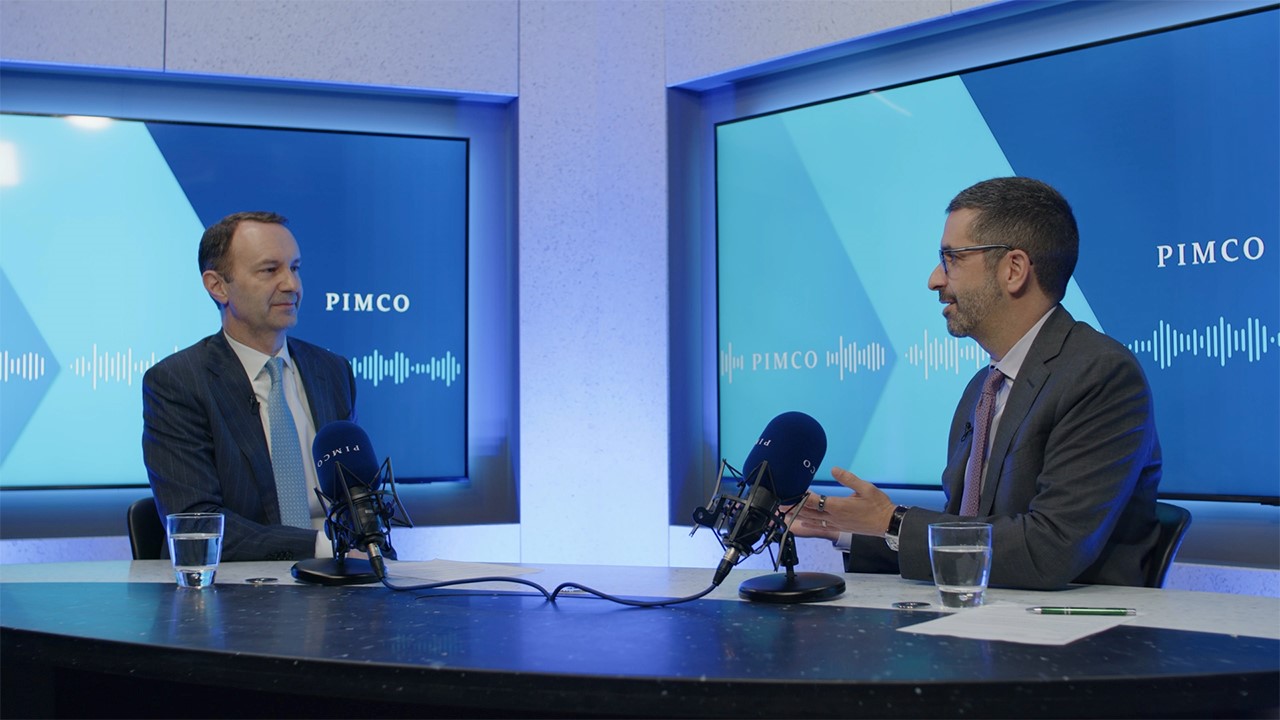
In this episode, Gordon, Chair of PIMCO's Global Advisory Board, rejoins Andrew Balls, PIMCO's CIO of Global Fixed Income, to assess how that picture has evolved, and why politics is increasingly driving economics.
From the Middle East and Ukraine to U.S. China rivalry and the race for AI, they explore the forces reshaping the global order - and what they could mean for policy and markets in the years ahead.
Andrew Balls: Gordon, great to have you here today. It's one year ago that we did this podcast for the first time. So the first question just wanted to look back at events over the past year. When you're talking with PIMCO colleagues, you've often stressed two themes. The first one is politics driving economics.
The second one is the move from a unipolar world to a multipolar world. So with that in mind, let's look back on the last year. Things have played out as we expected? Where has that been expected? Where have there been surprises?
Gordon Brown: I think we've seen an intensification of these seismic shifts that I would say are taking place in the world.
I mean, it's remarkable in one sense that the economy has continued to grow. So, you've got 3% global growth, 4% China, 2% or more in America, about 1% in Europe, roughly what you would have expected. So, weathering the storm has been an important part of the last year. But there are two phenomena that are really world changing.
And the first is the impact of AI, which we can talk about. And the second is what you've just raised, the seismic shifts taking place in geopolitics. And I said last year I thought there were three things that were happening, and I think they're all intensifying, actually. And war, in a sense, is a locomotive of history.
And I think war is actually intensifying the shift, first, to a multipolar world from a unipolar world which was completely dominated by America. America cannot now have its own way. You see in the Straits of Hormuz, it cannot just impose its will in the way that it used to. You know, 20 years ago, Putin would never have thought of invading Ukraine, but now he feels that there's an opportunity for him to cement some ambitions for aggression in Europe.
The second thing is worse than it was: protectionism. Now, the American tariffs are not now as big as they were at the beginning, and so they've been reduced by court action and by a number of other settlements that President Trump has made. But you're seeing more protection made in Europe is now becoming a big issue,
and therefore protectionism of European goods against what people call the China Shock 2.0. And I think that's going to become a bigger issue over the next few months. You've got protectionism in Asia against China's overcapacity as well, and you'll have a real retaliation from China against Europe. So I think protectionism is still such a huge issue, and it's not going to get better, although the American tariffs have lessened and people are finding a way around it. So trade itself is maybe becoming more regional, but certainly trade has not suffered as much as people might have expected. But protectionism is there. And I think the third thing is probably more obvious now, and that we're moving from a rules-based order to a power-based order, and that really is not just the Putins and the Xis and the Erdogans and, you know, saying, you know, power is what matters. If I've got the strength, I'll use it. I'm not going to abide by the rules of the game that we used to abide by. And then you've got this arbitrariness, which, you cannot really predict what President Trump is going to do in so many different ways.
You know, I think I said last year that he'd met the Japanese trade envoy, and the Japanese trade envoy had worn the cap, Make America Great Again, in the Oval Office, and Trump reduced the tariffs a few weeks later. He then met the Switzerland, the president, on a video call, and she was complaining about the threat to her of tariffs, and he came off the call and said, "I don't like the way she talked," and put the tariffs up. And so this arbitrariness is, I think, a big problem because it means the unpredictability of events. So I would say that partly as a result of conflict, the trends that we identified in a changing world, and it's not going to ever go back to where it used to be, are
I think we look for these theaters to abate in terms of the intensity of conflict, and I think that's the question. And perhaps you want to talk about Ukraine and then about the Middle East and then about the China-US standoff. So these are the three theaters. I think the Arctic may become another theater, which becomes problematical.
But I think the three theaters are going to determine what happens over the next year in terms of geopolitics.
Andrew Balls: So I want to come back to AI, I want to come back to US-China. Let's start, though, with the Middle East. You know, very important in terms of markets this year, bond markets this year, the situation in the Middle East. How, over time, how lasting will the impact on the geopolitical landscape be? Is this a big break in terms of the evolution of geopolitics, or do you think this is something that can be contained?
Gordon Brown: Yeah. The very fact America is now energy independent means that the Middle East is not as important as it used to be to America, but it is still important to the world, important to China, important to Europe.
And I should say that politics determining economics in three ways is important. The first is, obviously, every country is having to increase its defense expenditure, and security decisions are influencing economic decisions: trade bans, investment bans, technology bans. The second is the rise of populist movements, and that's not just the sort of parliamentary movements of the far right in Europe and Latin America, for example.
It's also what we're seeing, extra-parliamentary demonstrations. But the third is this geopolitics, and of course, the major theater is the Middle East. Now, the issue here is becoming more and more complex because you've got four different centers of tension. You've got Gaza, you've got Iran itself, you've got Lebanon, and now you've got Yemen. And it's difficult to see how there is one sort of overarching solution to the problems that we now see in the Middle East: Saudis against the Houthis in Yemen, and Britain and France supporting them, but not America, in defensive postures.
But that is a conflict which is basically a long way to run. And then, of course, Iran. We see in the New York Times, and we're talking this morning on a Thursday, predicting that after the midterm elections, Israel and America have agreed on further escalation of the war against Iran, which would be bombing of Iran itself, and that would intensify the conflict and almost certainly lead to further closures of the Straits of Hormuz, and therefore a reduction in the supply of oil. So you cannot predict at the moment that the tension in the Iran-American relationship is going to ease very quickly, if that is what is going to happen. And there's no reason, I think, that the Iranians now see that they should settle. And that's one of the problems. Their economy has done badly.
People are suffering, but they seem to manage to maintain the regime even in the presence of lots of internal opposition. So I think the Middle East carries with it the continuing danger. People will find ways around the supply of energy, and therefore I don't think the energy issue is purely a matter of what happens in the Straits of Hormuz.
But I think that the conflict in the region is not going to ease very, very quickly, and it's mainly because there's no one solution and no obvious solution. And I think that's going to take time. But people will find a way around the energy blockade, and I think people will find a way around the trade blocs as well.
Andrew Balls: I wanted to ask you about US-China. You talked before about AI and the impact on growth, but also about regional trade blocs. So it's a situation we're moving to a world in which you have competing technology trade blocs and a separation, and countries needing to choose between the US-led bloc and the China-led bloc.
Gordon Brown: This is the one world, two systems future that people fear, that you will have an AI system that is state-dominated in China and an AI system that's dominated by the hyperscalers, so to speak, in America.
But you'll also have different cybersecurity regimes. There are no nuclear weapons agreements either with China or with Russia and America at the moment, so that is something that is out of control. I prefer to see China as a competitor than simply as an adversary. But there's no doubt that when Xi met Trump a few days ago, and they're going to meet very soon again, very little came out of it in terms of any long-term agreements.
Xi, I gather, wanted to talk about AI, but Trump has said publicly that he thinks it's a race, and therefore the idea of an agreement is not acceptable to him. The problem with the China-US relationship is, let's say you solved one problem. People complain about the appreciation, the depreciation of the renminbi.
So, IMF says it's 16% undervalued. Let's say that China made some concessions on that. You've still got the problem of overcapacity, you've still got the problem of subsidies, you've still got the problem of what is seen by America to be the theft of technology and so on and so forth. Then you've got AI, you've got cyber, then you've got Hong Kong, then you've got Taiwan, then you've got religious minorities.
So, to solve one problem doesn't mean you've solved every problem in terms of this relationship. And in each issue, you've got the potential for things to become a crisis. And I think that's what we've got to bear in mind, that China now talks about strategic stability as the aim of the relationship. It used to be strategic managed competition.
Now they've changed to strategic stability. And I think what they're hoping for is a lull in the tensions as long as possible. And I personally think that they fear that at some point now, whether it's over Taiwan or over the economy, the relationships will deteriorate very dramatically, and they're preparing for that through trying to be more self-sufficient themselves.
Taiwan is obviously the most difficult issue. They want to be militarily ready to take over Taiwan in 2027. People who are the seasoned observers there think 2028 is the year. If the Taiwanese elect a government committed to the independence of Taiwan for a fourth time, then China may think that this is the time to intervene.
And certainly, the military preparations that they're doing at the moment, as China, are not simply to frighten Taiwan. They actually look to me, from what I've been told, as preparations for either a blockade or an invasion at some point. Now, Xi has got to make a decision, hasn't he? The economic future of China depends on that stability.
It is broken if there's an invasion of Taiwan. There's bound to be sanctions. There's bound to be a rebellion on many of the countries in Asia. And even if there was not military action by the West, there would be economic disruption. And that puts at risk his main aim, which, of course, is to move to becoming a high-income country.
So, he would have to balance off the threat to the economy posed by an invasion of Taiwan as against his desire to achieve this as part of his own legacy. So, these are the issues that I still think confront the China-American relationship. But at any point, I think you could have difficulties over a number of issues.
Andrew Balls: On the European side, is there, sticking with AI, is there a role for Europe in terms of the AI revolution? I mean, kind of sadly, when you hear it on the, read it in the FT or hear it on the Today programme, it's often about kind of Europe and the regulatory response to AI, something which is happening in the US, happening in China. Can Europe, UK, Europe carve out a role here?
Gordon Brown: Well, Andy Burnham, the new British prime minister, has said that he wants the G20, which Britain will chair next year, in 2027, to have as its main focus AI and the economy, which means, I think, that he would like to see, and we'll hear from him, I think, soon on this, he'd like to see this AI Safety Institute that has been created by Britain more at the center of how people see the future of AI. And I think this is going to be the issue. You've got, obviously, the consumer protection issues, you know, AI systems giving wrong advice. You've got the jobs issue about people worried about the future.
And certainly there's, I think in those areas about to be affected by AI, there's going to be less recruitment already. And you've got the issues, of course, community objections to data centers on the grounds of the use of water and energy and noise and everything else. But I think the biggest issue that people worry about is whether you have out-of-control systems.
And I think that's where you need some form of supervision. Yes, it's true that America says that America invents and Europe regulates. And yes, you've got this problem that China's AI system is it's state-run. So the market is not playing as important a part as in America. But I do think that over the next few months, where we see a number of incidents affecting what AI systems are doing, if these things are the kind of things that worry people, then I think there will be a move and probably a popular pressure. And I think we see it in the American midterm elections. A lot of the governors, rather than the Senate or congressional candidates, they're calling for supervision of AI and action in their own areas.
So I do think over the next few months that's going to build up. So it may be that the economics of AI are going to be influenced very much by these political pressures.
Andrew Balls: Yeah, and Libby Cantrill will stress that a lot on the US side. And it's interesting, it's not just the Democrat side, the Republican side.
Gordon Brown: No, the Republicans as well. And I think, you know, it is partly this reaction against data centers, which, you know, I think maybe is overdone because, obviously, you can come to some agreement about the use of energy and the use of water. But I think it's this idea that they can get out of control that really does worry people.
And you can see that the public opinion is rising on this issue, and we've got to take it into account. And I think there's got to be some way that you must have failsafe systems where an AI system has to be closed down at a point at which it's breaking out in a way that is going to affect lots of people.
Andrew Balls: I want to talk about European politics. I want to talk about UK politics. Before that, we've mentioned Russia-Ukraine, more than four years now into the...
Gordon Brown: Longer than the First World War, Andrew. That's the tragedy.
Andrew Balls: How do you see the outlook there? Is there the prospect for some sort of settlement?
Is this going to be an ongoing frozen conflict? How do you think things will...
Gordon Brown: As we were talking, there's obviously discussions taking place. It's interesting, the discussions are between Russia and America without really involving Europe to any real extent. So, I'm not sure that you can get a settlement if Europe is outside the picture on the discussions.
But we are facing the worst winter, there's no doubt about that. If you don't get some sort of settlement, then there are going to be more casualties. One, because American interceptors are being withdrawn because of the use of them elsewhere, and therefore the bombing of Kyiv and infrastructure, or the drones that are coming in on them, are not able to be distracted and thrown back as a result of the use of interceptors.
So, Ukraine is more vulnerable this winter than last winter, to be honest. And the Russians have realized that, and therefore the drones and the missiles are getting through in a way that they weren't. So, I would expect more civilian casualties, and that is something that, of course, people worry about. Now, can you get an agreement? Because there is still an area of the disputed region, Donbas, that is not controlled by Russia, but they want to control it.
Now, people say, well, you could have an agreement: Crimea plus the region become Russian. But there's no way that the Ukrainians are going to accept that as a de jure, you know, as a legal sort of obligation on them to hand over complete control. The best you might hope for, if there was to be a settlement, is that it was de facto, and so it would still be, as you say, a frozen conflict or an armed truce or whatever words you want to use. So a bit like the Middle East, it's difficult to see a solution that could actually be accepted by both sides in the absence of complete victory by one side over the other.
So, I would say that while you might have a ceasefire and you might have an armed truce for a while, it's not going to be a resolved issue. A part of the American negotiation seems to be that Ukraine would be accepted as a member of the European Union if Ukraine then accepted it lost these vital parts of Ukraine that we've just talked about.
But I find that something that will be difficult for people to accept. And people are already, in America, I see that Mitt Romney has just used the terms that this is like a concession that was made to the Nazis during the Second World, before the Second World War. The Sudetenland went to Germany, then Czechoslovakia went to Germany, but that never satisfied their ambitions. And so Poland became the theater in which the war had to be declared. And so I think what people say is, if Putin's ambitions are met in one respect, he will simply add to that. And there's no doubt, you know, I've been very clear about this, I met Putin maybe 20 years ago for the first time, that what he understands is strength.
He will exploit any weakness. And it was when we'd been weak over Crimea and then weak at the start of the Ukraine invasion. Then we reacted heavily, which was good, but we were weak, and he sensed a weakness. And if we give in too much, I think this will be not a recipe for peace, but a recipe for further aggression.
Andrew Balls: There was a proposal, I think it came from the Russian side, the proposal for the US, China, Russia to meet and decide an outcome, so not including Ukraine, not including the Europeans. So what can the Europeans do, Europe and the UK? Is there something that they can do to try and bring about a better outcome?
Gordon Brown: I think we've got to show we're stronger. I mean, the NATO alliance has got to be stronger. One of the proposals is for joint procurement so that we actually strengthen the procurement of the right kind of weaponry and get the right kind of technology made in Europe as well as in America, so that we're ready to face the future.
We've got the Arctic problems emerging as an issue because, as the ice melts in the Arctic, then this waterway becomes something that is of interest to China, to Russia and to America and Europe. And so you've got the potential for tension there. So defense expenditure, and this is why politics has become more important to economics, defense expenditure is bound to rise. In 2020, I think Europe as a whole, the NATO members of Europe, spent about 1.75% of GDP on defense.
By 2035, that's to be 3.5%. So that is a doubling in real terms of expenditure on defense and security, which means, of course, the strained budgets of European countries in doing so. But there is a sense that there is no choice but to do that. So I think Europe's got to be serious about improving its defenses.
I think you've got to be more coordinated as a continent in the way we do it. And I think any, you see, if Le Pen were elected in France and the AfD made progress in Germany, both these parties are very soft on the Soviet Union. And therefore that is another message, the populists, the sort of support for these parties is sending a message to Putin that he could actually increase his aggression.
What's the effects on the economy? I think Europe has managed to absorb many of the energy impacts, shift to renewables, other sources of energy, LNG from America as well as, you know... But I do think the defense expenditure is putting a huge strain on the fiscal positions of European countries.
Andrew Balls: So, let's turn to Europe. We have elections approaching in Spain. We have the French presidential elections, April, May next year. I think we have elections in Italy as well next year. Is this going to be an important, decisive period in terms of European politics?
Gordon Brown: I think you said that for a number of years, but half of Europe goes to the polls next year.
So, it's Poland and it's Finland and it's Slovakia, I think, as well as the countries you've mentioned. I mean, the most important election will be the French one, but Spain comes first. And so it will be very interesting to see whether this sort of right-wing Vox party makes an impact on the Spanish elections, whether the Popular Party, which is the right-of-center party, which is favorite to win, of course, capitulates in their policies to the far right to get them into the coalition.
And so what you're looking at in Europe is whether there's going to be a real change in policy, not just because the far right is doing better in Germany, France and Poland and so on and so forth, but because the center right adopts many of their policies. And I think that's what you've got to look for in France, in Italy, in, obviously, Poland and Spain, which are the major countries in Europe which will affect the destiny of Europe.
So, Le Pen is saying, yes, she will stay part of the European Union, but she's demanding a massive cut in the French contribution to the European Union, a rebate, so to speak. And most of her savings, because she wants to present herself as fiscally responsible, well, many of them come from actually cutting the contribution to the European Union.
But again, if you start cutting the contribution to the European Union, that puts the Ukraine support at risk, and therefore you have a big disagreement right at the center of the European Union on both support for Ukraine and the commitment to European policy generally, agreed with a sort of relatively low budget anyway, but one that would be decreasing as a result of what Le Pen pushed on Europe.
So, I think what you're looking for in the next year is not so much that a far-right party is going to get a majority. That's not going to happen. But Le Pen may win on a second ballot and get over 50% then, and the right may get into coalition, the far right may get into coalition, but also influence the policies of the center right, if these are the parties that win, in a way that is probably anti-growth, anti-environment, anti-trade, anti-immigration, obviously.
So, these are the sort of things that you would be looking for as big changes in European policy. Europe's still got this huge issue, I think we all agree, that its growth rate is too low, its productivity is too low, it hasn't invested enough in the new industries. The Draghi report recommended this, but of course it requires some state funding as well as some private funding, and it's been far too slow in the implementation. And it's held back by this rise of populist nationalist movements, which are now, of course, on the streets in Europe as well as in the electoral arithmetic. And to see riots in France and to see, you know, water cannons in Belgium, to see states of emergency in Albania, for example, and, you know, some other countries where things are actually happening at the moment, suggests that it is going to be quite a turbulent year ahead.
Andrew Balls: On France, France has become, it's come under market pressure. The French OAT 10-year spread over Bunds has gone from 50 over to 150 over. Budget stalemate, protests, as you alluded to, and then the presidential election to come. How concerned should we be about this situation in France?
You know, what is the potential there for instability versus kind of a more positive outcome, higher yields leading to some kind of greater realism in terms of the fiscal debate?
Gordon Brown: Well, it's interesting. It hasn't spread, in the sense that the market turmoil hasn't spread to the rest of Europe in the way that perhaps would have happened 10 to 15 years ago when we had the euro crisis.
But it is also true that France doesn't seem to have a way of sorting out its problem with its deficit, because there's a tension between the president and the National Assembly. The debt level is above 100%, and of course, growth is relatively low in France. I do think that no matter what happens next year, it will remain quite an unstable situation, because if Le Pen gets elected as president, it's doubtful, I think, if the National Assembly would elect a Le Pen majority. If she doesn't get elected as president, it's possible that she would get a majority in the Assembly. France has got a way of having one person in the president who shares the left-wing view or the right-wing view and the opposite in the Assembly.
And I don't think people have quite realized that France is not a presidential state in the way that some people imagine America to be, that the National Assembly can control the budget and make it very difficult to get things moving, as is happening at the moment. So my worry about France is that it's a continuing problem until they can really get a grip of the public finances. And the public finances, of course, come back to issues like pensions, where, you know, most other European countries are raising the age at which people retire, given that people live so much longer, and the retirement ages were set at a time when life expectancy was very low compared with what it is now. So France is still 62. Britain and other countries are moving to 67, 68. And I think that's a decision that... It's surprising that Macron, with a majority in the Assembly when he started and also being, the power of the presidency, didn't manage to get that through, which shows that it's going to be very difficult for anybody to make that change.
Andrew Balls: Yeah, no, absolutely. I think Bismarck chose 65 because that was life expectancy in Germany. So the idea was, if you lived beyond the average, then you would get support.
Gordon Brown: That is such an emotional issue, of course, because, you know, many pensioners do not live beyond 65 or 62. So it's quite, it's quite... I had to supervise a change of that in Britain, and we recommended 67 and then 68. And it's very difficult because there is a lot of emotional energy bound up in that kind of debate. So what we offered, a completely new plan for pensions, where we had an earnings link, which, of course, is something that's now under question, replacing the inflation link, at the same time as offering, or requiring, the rise in the pension age.
And I think you've got to have some sort of plan for the future of pensioners' benefits and health care and social care as a whole if you're going to get these changes through. And I think if you could put that plan to most countries in Europe, they would accept it.
Andrew Balls: Let's turn to the UK. So we're talking a week before the UK budget, so I won't ask you for your budget predictions. But in terms of the bigger picture, the IMF, in its World Economic Outlook, gave some praise to the UK, standing out for actually having made some progress in bringing down the deficit from five and a half to four and a half, but saying the UK government needs to stay the course and, you know, stay on the plan to get down to, say, three and a half. You know, how likely is it, given all the political pressures, that the Chancellor, Healey, who you know well, will be able to stay the course and stick with the plan for deficit reduction?
Gordon Brown: Yeah, he will want to stick to the plan, and the plan actually is 4% to 3% to 2%. And I think in 2029-30 or 2030-31, it's 1.6%. So it is a fiscal consolidation plan over four to five years. And the question that you're asking, rightly, is, are these figures just thrown in there without the hope that they're going to be necessarily achieved, or are the government serious about it?
My view is that his budget will reconfirm these figures. But what you've got is a mixed picture in Britain at the moment. You have, the deficit is coming down. You have also growth higher than was expected and productivity probably higher than people had thought. But at the same time, you've got higher inflation now, and inflation probably going to go above 4%.
And of course, the deficit last month was higher than people expected. So he goes into the budget with a mixed picture. But the fundamental problem in Britain is actually similar to the one in Europe, and that is the low level of growth. I mean, you know, 20 years ago the growth was 2.5%, or 2.25 to 2.5%.
Now, average growth is hovering around 1%, or 1 to 1.5%. Now, you cannot afford the level of social provision that you want to afford unless you can get this growth level up over time. And of course, the main objective of a budget has got to be an economic event rather than just a fiscal event, to try to take the measures necessary.
Britain's got this great innovative genius in the creative industries, but also we're doing quite well in AI, quantum computing, medical technology, environmental technologies. And so there are areas where we've got the innovative breakthroughs that could make a huge difference. But what Britain has failed to do is have the scale-ups at the size of America, or the size that you want to see if you're going to be internationally competitive over a long period of time, exporting to the rest of the world with a unique kind of product or service.
And I think that's really the challenge for Britain, to get the growth rate up by higher productivity through more innovative clusters in our economy, that instead of just having great start-ups and great universities, you know, Britain's got four of the top 10 world universities, 16 of the top 100, and 10 of them are outside the Southeast.
So, it's not just a Southeast issue in Britain, but we haven't managed to, even with the research papers that, you know, I think with 1% of the population, we've got 6% of the world's research papers, and I think 12% of the most cited research papers. So, we are ahead on some of these innovations, but to turn that into high levels of growth is what the real challenge is.
And I think the budget, and then the 10-year plan of the government, that's what they will want to do, to show that they can raise the growth rate. And if you could raise the growth rate, then some of these public spending and fiscal problems would be less obvious. And of course, the problem with this is it takes time. People have got to think that your proposals and your program is credible.
Andrew Balls: We started off with the theme of politics ahead of economics. Andy Burnham has, Prime Minister Andy Burnham has talked about the possibility of moving closer to the EU, up to the point of rejoining the EU. Is this kind of a classic example of the politics getting well ahead of what's really likely in terms of the economics?
Gordon Brown: Well, I think the evidence is now quite clear that Britain really had about half its trade with the European Union, and we have lost, Britain has lost a lot because of the changeover. So, what's going to happen is there's a European-British agreement summit in the next few weeks, and they're going to make some changes.
So, they're going to change some of the rules governing food and farm products, so make it easier to sell to Europe and to buy from Europe; youth mobility scheme; so changes in the way we deal with immigration to stop illegal immigration. So there are changes taking place, but the big question is, at what point is he going to decide that he either wants to join the customs union or the single market?
It's estimated if you join the customs union, it's probably worth another 1% of growth over a period of years, and the single market far more, about 4%. So that's the issue that he will not be able to resolve, I think, before the next election. And the question for him is, does he put to the electorate at the next election that Britain rejoins one of these major parts of the European Union, and what the reaction would be, and then to decide whether that requires a referendum or not?
I think, however, what's going to happen in the next few years is something rather different in Europe than from what we might have expected. I think on defense, there's going to be so much more cooperation outside the European Union as well as inside the European Union, and that will involve Norway and Canada, Ukraine, countries outside the European Union.
I think on energy, there's going to be far more cooperation, particularly in the North Sea, where you could have a North Sea [unclear] with floating wind and hydrogen and carbon capture, and that will involve Germany to Norway, Belgium, Netherlands and so on and so forth. So I think you're looking for more cooperation in Europe over the next few years, within the European Union, but also outside the European Union.
And I think it's a variable geometry that we used to talk about, talked about, the future of Europe, is becoming more obvious, and Canada may start to be part of some of this as well, as Mark Carney seems to want. So I would look for these kind of changes. But the benefit of all these things would be higher growth as a result of more trade.
And I think on the procurement side, in defense, greater productivity as a result of more cooperation. So I think there are ways that Europe can improve, as well as the United Kingdom, improve its growth rate and its productivity.
Andrew Balls: So, it's a closer cooperation, which makes a lot of sense. But some of the idea, the EU rejoining, regardless of what one thinks looking backwards about the wisdom of leaving, but to rejoin: euro membership, free movement of labor, 30, 40 billion dollar, sorry, sterling, contribution to the EU budget.
Gordon Brown: That's gross, not net.
Andrew Balls: Gross, yeah. It seems like a, that seems like a stretch.
Gordon Brown: This is the issue, of course. You've got to solve the problem that the rebate was negotiated and it's not probably available in the same form. You've got to renegotiate that. But it is possible that you could get some agreement on that.
Free movement is, of course, an issue that is looked at now by every country in Europe. So, it's not really the same as it was 10 years ago, the way people see it, given the pressures of immigration into Europe. But yes, these are big, big issues, and these are issues that would concern the whole of the British public.
But I think the fundamental problem that Britain has is, can you grow as fast as you want to grow if your trade with your biggest competitor, or your biggest partner, is being affected by all sorts of blockages and all sorts of duties or tariffs? And if you take the British car industry, at its peak it was producing, I think, 1.6 million cars, and that's now down to 6 or 700,000 cars this year.
And the majority of our cars were being exported, and Europe was by far the biggest buyer of our cars. And that's one of the issues that is raised by this Made in Europe policy, which makes it more difficult for Europeans to take British cars without some sort of barriers to doing so. So, these are real problems about growth and employment and, of course, affecting standards of living, that have also got to be dealt with and solved in some way for the future.
Andrew Balls: Good. Well, it's nice. I'm going to take this as a point of optimism there. I think for improvement under the government.
Gordon Brown: The other optimism, Andrew, is, I think, that if you look at European public opinion, and I've been involved in doing some surveys of European public opinion, it's interesting to note that most people in Europe are not sort of of a mentality that is, you know, narrow nationalist, us versus them, zero sum in their mindset, "My country can only succeed if you fail," and that's the kind of politics I have. You know, 80% of the European public don't agree with that kind of view. And therefore, the rise of populist nationalism is not the rise of parties that are going to get a majority of public opinion on their side, but they will exploit people's dissatisfaction with low growth, poor living standards, failures in housing, for example, policy.
All these things will become issues. But generally, the European public is waiting to be won to a cause that would envisage more growth and the ability to do more about standards of living.
Andrew Balls: Wonderful. Great. We've covered a lot of ground. Thank you very much for joining. A great pleasure to do this tour of the world with you.
Gordon Brown: Thank you, Andrew.
VOICE-OVER: Thanks for joining us on Fixing Your Interest as we explored the evolving global political and geopolitical landscape.
Stay with us as we continue to navigate the challenges and opportunities across fixed income markets.
For more insights, analysis and resources, visit PIMCO.com.
From This Episode
Gordon and Andrew discuss how the geopolitical shifts they identified a year ago have intensified, even as the global economy has continued to grow. Gordon explains why he sees a world moving from a unipolar to a multipolar order, with protectionism on the rise and power increasingly taking precedence over established rules.
They examine the conflicts in the Middle East and Ukraine, the increasingly complex U.S.-China relationship and the prospect of competing technology and trade systems. They also explore AI as both an economic force and a source of growing political pressure, including the debate over regulation and Europe’s role in the technology race.
The conversation then turns to Europe, where elections, populist movements, defence spending and fiscal pressures could shape the political landscape. Closer to home, Gordon considers the U.K.’s challenge of raising growth and productivity, as well as the potential for closer economic cooperation with Europe.
Key topics include:
- Why politics is increasingly driving economics, and the shift from a unipolar to a multipolar world
- The outlook for conflict in the Middle East and the implications for energy and markets
- U.S.-China relations and the prospect of competing technology and trade systems
- The global AI race and whether Europe can carve out a meaningful role
- Russia, Ukraine and the possibility of a ceasefire or prolonged frozen conflict
- Europe’s changing political landscape, rising defence spending and fiscal pressures
- France’s political and fiscal challenges
- The U.K.’s growth and productivity challenge and the prospects for closer cooperation with Europe