





Secular theme: rupture and resilience
The global economy is no longer gliding along a familiar path of ongoing globalization and increasing integration. In the words of Canadian Prime Minister Mark Carney, the world is undergoing a rupture rather than a mere transition away from the post–World War II rules-based regime.
Last year, in “The Fragmentation Era,” we argued that the traditional relationship between politics and economics had inverted, with politics and protectionism increasingly driving economic outcomes. We warned that fragmentation would become an independent source of volatility, shaping business cycles and creating distinct winners and losers across companies, sectors, and countries. Since then, the world has witnessed significant changes:
- Escalating trade and economic security confrontations
- Resilient global growth – at least so far – in the face of these shocks
- A massive AI investment boom
- Emerging stresses and strains in lower-quality private credit and opaque financial structures
As we write this, the global economy is navigating a conflict in the Middle East that has triggered one of the biggest oil supply shocks in history. The implications are inflationary in the short term while the shock also signals the potential for demand destruction and a growth slowdown over time.
Resilience to be tested
We believe several powerful forces related to geopolitics, fragmentation, and AI will drive the global economy and markets over the next five years.
Geopolitical risk has become reality. Events in the Middle East underscored the vulnerability of global energy and trade networks to disruption at a handful of critical chokepoints. Risk premia that had been embedded in implied volatility are now being tested through realized outcomes. These dynamics complicate forecasting and increase the likelihood of episodic market stress, even if worst-case scenarios are avoided.
The pace of fragmentation is accelerating. Governments are playing a more direct role in shaping economic outcomes, extending state intervention well beyond traditional industrial policy toward the broader goals of economic security. Trade restrictions, export controls, subsidies, investment screening, and public procurement are now core tools of economic strategy. The U.S., China, Europe, and an increasingly assertive group of middle powers are pursuing distinct models of economic security. Supply chains are being reshaped not only for efficiency, but also for resilience and security.
Artificial intelligence has crossed a threshold. AI investment is now large enough to drive macroeconomic activity. The buildout of AI infrastructure, combined with rising defense spending and energy security investments, could add roughly $14 trillion to global capital spending over the next five years (see Figure 1).
Figure 1: Forecasting a consequential global capital spending cycle over the next five years

Capex on data centers, processing capacity, and power infrastructure is reshaping corporate balance sheets and sectoral dynamics. The productivity payoff could arrive faster, and prove more disinflationary, than many investors now expect. At the same time, AI is amplifying dispersion across companies, across industries, and across capital structures.
These forces are not independent. Fragmentation accelerates AI investment through support of national champions and the provision of sovereign infrastructure. AI, in turn, reinforces fragmentation by making computing capacity and energy strategic assets. Geopolitical risk overlays both, creating a secular environment in which baseline scenarios must be balanced against increasingly fat tails.
Geopolitics, domestic politics, and industrial policy are no longer external forces that occasionally disrupt the economy. They have become central drivers of growth, inflation, market returns, and volatility. For investors, the implication may be not just higher volatility, but also greater dispersion in returns across asset classes.
Energy and uncertainty
Uncertainty around the endgame for security alliances has increased downside risks to growth. Trade, payments systems, and energy flows have become tools of statecraft. As a result, shocks may propagate more quickly and with greater market impact than in the past.
Energy sits at the center of this uncertainty. Energy security is now inseparable from economic security, defense readiness, and the deployment of energy-intensive technologies such as artificial intelligence. Outcomes range widely: from higher-for-longer prices that pressure growth and inflation, to periods of sharp disinflation if supply responses accelerate or demand weakens abruptly. Regardless of the path, geopolitical risk premia in energy markets are likely to remain elevated over the secular horizon.
Relative to our baseline, risks to global growth are skewed to the downside. Broader or more prolonged conflicts – particularly those affecting major energy chokepoints – would raise the probability of policy mistakes and nonlinear market reactions. In this environment, uncertainty itself becomes a macro variable, shaping investment behavior and reinforcing the case for resilience.
China: transition under constraint
China continues an inevitable transition toward a lower long-term growth model, paired with an aggressive push to dominate strategic industries while maintaining an annual growth target. While trade tensions with the U.S. remain acute, China’s export capacity continues to exert disinflationary pressure on global goods prices. At the same time, rising debt levels and limited fiscal space constrain policymakers’ ability to rely on demand-side stimulus.
China remains a pivotal player in global fragmentation, is an ongoing source of global disinflation, and holds significant strategic and geoeconomic leverage that it brings into international trade and security discussions.
Emerging markets: an unusual inflection point
The same forces driving rupture in the developed world – U.S. dollar rebalancing, supply chain rewiring, energy security investment, and AI infrastructure buildout – are creating a differentiated opportunity set across emerging market (EM) sovereign and corporate bond issuers. Countries with credible central banks, commodity export capacity, and the scale to capture larger shares of the global supply value chain are seeing fundamentals converge toward, and in some cases surpass, those of lower-rated developed market (DM) peers.
AI has arrived
AI is no longer a wild card but has become a core component of our secular outlook. Investment is already reshaping demand, while the productivity uplift may arrive sooner than many expect. Over time, AI is likely to be disinflationary across many sectors, particularly if it compresses labor costs and improves efficiency.
For investors, the key implication is not simply to identify beneficiaries, but to recognize that dispersion is widening and that poorly positioned, highly leveraged businesses are increasingly exposed.
Policy space: monetary and fiscal
We expect central banks to do what it takes to keep inflation expectations anchored. That said, central banks today have much more conventional policy space than in the decade before the pandemic, and we expect them to use it and cut rates in a future recession. For this reason, sovereign bonds offer income plus the potential for capital gains in a future downturn – a noteworthy point given the historical frequency of recessions (see Figure 2).
Figure 2: Historical frequency of U.S. recessions over five-year periods since World War II has been 69%

By contrast, fiscal space is limited across almost all advanced economies. In the U.S., elevated debt and persistent deficits also limit fiscal space, but do not, in our baseline view, imply that a U.S. fiscal crisis is imminent. Moreover, the dollar should remain the dominant global currency, though its valuation may gradually adjust as global portfolios rebalance and demand for hard assets rises.
The dollar’s reserve status affords the U.S. more flexibility than other sovereign issuers. While debt remains sustainable in the short to medium term in most DM economies, the U.S. remains on an unsustainable trajectory under current policy, which continues to kick the can down the road. High deficits will need to be addressed eventually. In the meantime, a weaker fiscal backdrop tends to lead to higher real interest rates, which should benefit investors.
Investment implications: resilience, not reach
In 2024, we titled our Secular Outlook “Yield Advantage” to highlight a generational reset in bond yields. Two years on, we believe that thesis has only strengthened. In a world characterized by rupture – geopolitical, economic, and institutional – the case for building resilient portfolios without reaching for risk is stronger today than it has been in years.
The low-yield era following the global financial crisis was a historical anomaly. The reset in global yields over the past several years (see Figure 3) has restored fixed income’s role as both a return generator and a shock absorber, at a time when equity valuations and private market leverage leave less margin for error.
Figure 3: Fixed income yields remain compelling and signal attractive return potential

This greater yield “cushion” can provide bonds a secular advantage, with the opportunity for strong performance across a wide variety of potential scenarios:
- Deflationary pressures arising from AI-related efficiency gains
- A potential disappointment in AI-related efficiency gains that slows equity-led economic gains
- Growth shocks that lead to central bank rate cuts
In the past, bond investors often had to choose between desirable characteristics such as attractive yield, high credit quality, and diversification benefits. Today, investors may be able to realize these attributes together.
The defining investment implication of our secular outlook is not that risk should be avoided, but that investors should be paid for risk – and that investors no longer need to stretch to achieve reasonable long-term returns. High quality fixed income may once again offer income levels competitive with long-run equity returns, with materially lower volatility and strong potential across a variety of scenarios, particularly in a downturn. In an environment of fatter tails, that matters.
Fixed income’s value proposition, in absolute and relative terms
Over multiyear horizons, fixed income returns have historically been largely anchored by starting yields. Today, those starting yields look compelling. The yields on the Bloomberg U.S. Aggregate and Global Aggregate (hedged to U.S. dollar) indices, two common benchmarks for high quality bonds, are about 4.71% and 4.75%, respectively, as of 4 June 2026.
Using that as a baseline, managers with global mandates can construct diversified portfolios yielding 5%–7% in local-currency terms without necessarily compromising quality or liquidity. Bond yields continue to appear more attractive relative to cash for a modest increase in risk.
The comparison with equities is increasingly stark. Equity valuations remain elevated relative to history, and the equity risk premium – particularly in the U.S. – sits near the low end of its post–World War II range (see Figure 4).
Figure 4: Equity valuations remain stretched, with U.S. equity risk premium near zero
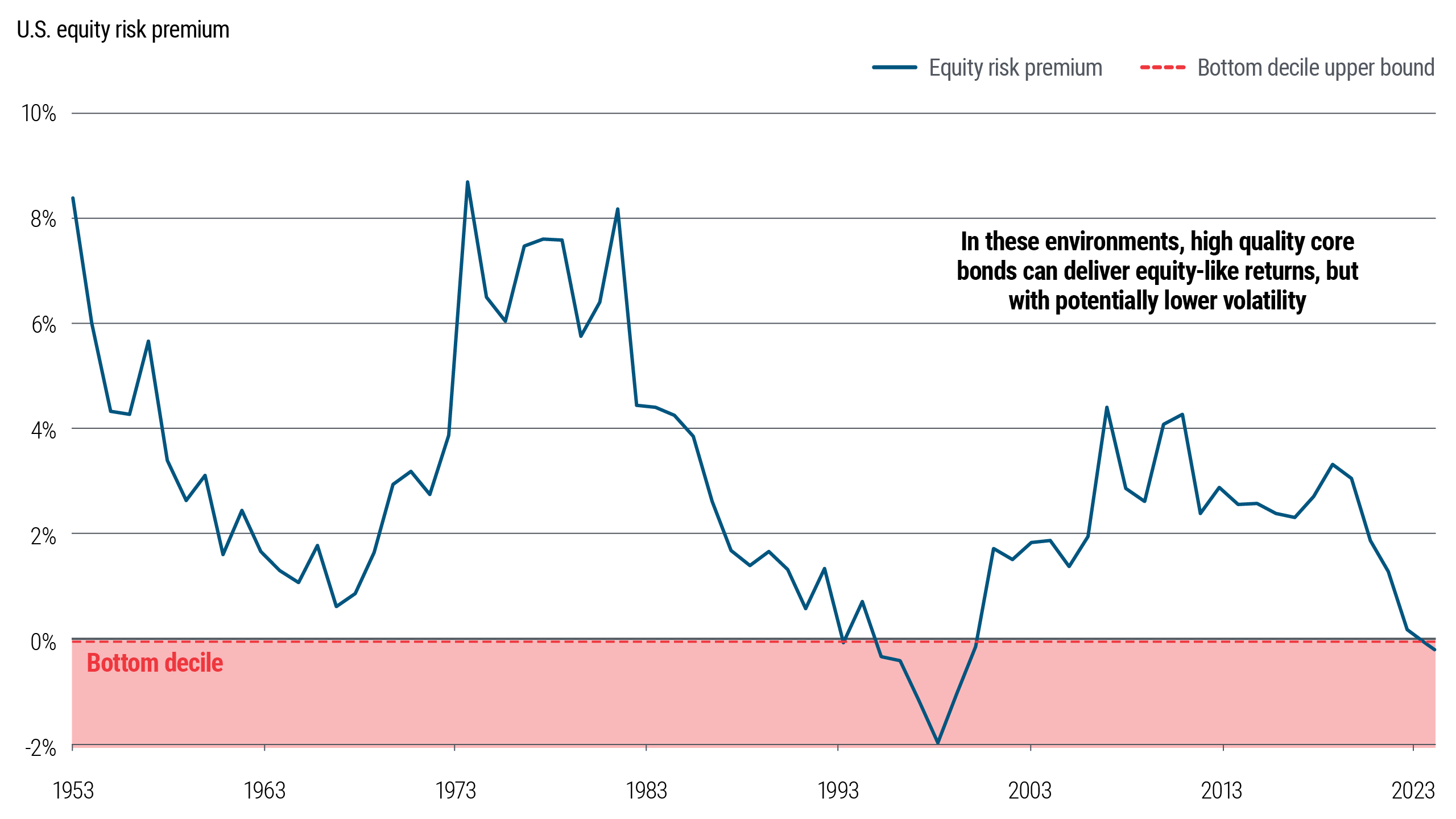
We are not calling for an imminent equity correction. But we do believe that the prospective Sharpe ratio – a gauge of risk-adjusted return – of high quality fixed income now compares favorably with equities for the first time in many years. This argues for reconsidering portfolio allocations that were shaped during the low-yield, low-volatility decade following the global financial crisis.
We continue to believe that the traditional 60/40 stocks/bonds framework again warrants attention after equity exposures for many investors have drifted higher. Fixed income can once again do more of the work it was always meant to do: generate income, dampen volatility, and provide ballast during risk-off episodes.
High quality fixed income: where the opportunity sits
Within high quality fixed income, our highest-conviction opportunities remain concentrated in a few areas.
First, intermediate-duration bonds continue to offer an attractive balance of yield, roll-down, and risk. The five- to 10-year segment of global yield curves looks well compensated relative to both shorter-dated cash and the long end, where fiscal dynamics and term premium uncertainty argue for caution.
Second, agency mortgage-backed securities stand out. These securities trade in a deep and liquid market. Spreads remain wide relative to history, credit quality is high, and supply/demand dynamics are improving as bank balance sheets stabilize and the Federal Reserve’s footprint recedes. In our view, this combination can offer an attractive source of income and diversification.
Third, global government bonds merit renewed attention. Business cycles are increasingly desynchronized, and monetary policy paths are diverging across countries. A global fixed income allocation can seek the potential benefits of global diversification and strengthened risk-adjusted returns over time. It can create opportunities for active country selection – including EM countries with credible policies and strong fundamentals – and curve positioning that were largely absent during the era of synchronized global easing. At today’s starting yields, global bond exposure should help provide diversification alongside the potential for higher income. With the U.S. on an unsustainable long-term debt path, owning non-U.S. debt can be a prudent way to diversify.
Finally, inflation-linked bonds and select real assets often play an important role in resilient portfolios. With inflation tails fatter and geopolitical risks to energy elevated, real (inflation-adjusted) yields that are positive by historical standards can help provide a meaningful buffer to volatility. Gold, in particular, has continued to serve as a neutral store of value in a world of partial confidence in fiat currencies.
Credit: the dispersion is the opportunity
Credit markets, in aggregate, continue to price a benign outcome. Credit spreads across investment grade, high yield, and private credit remain near the tight end of historical distributions despite elevated secular uncertainty. We interpret this as complacency rather than strength.
Years of abundant capital and “buy the dip” behavior have encouraged aggressive underwriting, high leverage, and widespread use of floating-rate structures. Now, the credit loss cycle is upon us. We are particularly cautious in lower-quality, economically sensitive corporate credit. Even in a strong economy, AI will disrupt old economy companies, especially highly levered ones.
As growth slows and refinancing costs remain elevated, stresses are emerging – most visibly in segments of private corporate credit and middle market direct lending. We are witnessing increased instances of maturity extensions and payment-in-kind structures that allow borrowers to repay debt with more debt. In our view, a more genuine default cycle is now unfolding, and investors should not expect past patterns of rapid recovery to repeat with the same reliability.
By contrast, we continue to see more attractive risk-adjusted opportunities in asset-based finance. Areas such as equipment finance, consumer lending, residential mortgages, real estate credit, and select infrastructure finance benefit from strong collateral, granular diversification, and cash flows that are less directly tied to corporate earnings. At current valuations, these characteristics can offer what we see as a superior balance of income and source of downside protection.
Watch the financial engineers
As capital becomes scarcer and balance sheets seek growth, we expect financial engineering to accelerate. This is most evident in private credit, private-equity-adjacent structures, and insurance balance sheets, where incentives to source higher-yielding assets are powerful. We also see it playing out in more specialized ETFs, such as passive and leveraged exposures to less-established areas of the market. We do not view this as systemic, nor do we see parallels to the buildup of risk that preceded the global financial crisis. But it bears scrutiny.
Credit selection matters and investors should get paid to provide liquidity. An investment grade label does not always imply investment grade risk, particularly when ratings rely heavily on structure rather than underlying asset resilience. Highly engineered financings related to AI or reinsurance vehicles warrant especially careful analysis.
At the same time, the AI buildout is also driving significant infrastructure financing needs, particularly in bonds and loans, creating opportunity for lenders with discipline and scale. Focusing on deals with claims on hard assets and strong documentation can help investors seek steady returns while mitigating risk (for more, see our 29 May commentary, “Investment Discipline Amid the AI Infrastructure Boom”).
Opportunities across EM
The starting yields available today across EM local and hard currency markets are among the most compelling in over a decade. There is also potential for secular U.S. dollar weakness, historically among the most powerful tailwinds for EM local currency returns.
Emerging markets have become an underappreciated tool for risk management. The intuition is straightforward: EM can often offer yields meaningfully above those of comparable-duration DM instruments. The deeper insight in today’s macro backdrop is that EM now also provides important portfolio diversification against the very disruptions emanating from the developed world itself. In a regime where U.S. fiscal dynamics, dollar rebalancing, and DM policy uncertainty are the primary sources of portfolio risk, EM exposure can offer a genuine hedge rather than simply an additional source of yield.
In hard currency, select sovereign and quasi-sovereign credit – particularly among commodity-exporting frontier and investment grade issuers – can offer spread compensation that often more than accounts for idiosyncratic risk. Beyond public markets, EM private credit and structured finance, including infrastructure finance, asset-based lending, and development finance institution (DFI)-partnered structures, represent an expanding opportunity set that can combine those potential yield benefits of EM with the collateral discipline of asset-based finance.
Putting it together
In a post-rupture world, the most consequential investment mistake is reaching for risk when that risk is poorly compensated. We believe the current yield environment offers a compelling alternative.
We believe resilient portfolios today are built around liquid, high quality fixed income, an up-in-quality bias in credit, broad global diversification, and selective exposure to real assets and asset-based finance. Over the next five years, discipline is likely to matter more than daring – and resilience more than reach.
2026 Secular Forum guest speakers
- David Chen – Head of Global Technology Investment Banking at Morgan Stanley
- Jim Covello – Head of Global Stock Research at Goldman Sachs
- J.R. Gibbens – Principal at Highlander Partners, former service to the U.S. Treasury and U.S. Department of Defense
- Tyler Goodspeed – Chief Economist at ExxonMobil, former Chair of the White House Council of Economic Advisers
- Andy Laperriere – Head of U.S. Policy at Piper Sandler, Co-founder of Cornerstone Macro
- Ruth Porat – President and CIO of Alphabet and Google
- Gina Raimondo – Distinguished Fellow at the Council on Foreign Relations, former U.S. Secretary of Commerce, former Governor of Rhode Island
- Kenneth Rogoff – Professor of Economics at Harvard University, former Chief Economist at the International Monetary Fund
- Ben Samild – Chief Strategist at the Abu Dhabi Investment Council, former CIO of the Future Fund Management Agency
- Ruchir Sharma – Chairman of Rockefeller International, Founder and CIO of Breakout Capital
- Silvana Tenreyro – Professor of Economics at the London School of Economics, former Monetary Policy Committee member at the Bank of England
- PIMCO’s Global Advisory Board – World-renowned experts on economic and political issues


