



Please stay tuned after the conclusion of the podcast for additional important information.
GREG HALL: Hey everybody. Welcome to another episode of Accrued Interest PIMCO's podcast, dedicating to serving financial advisors and the wealth community. As always, my name is Greg Hall. I'm your host for the program.
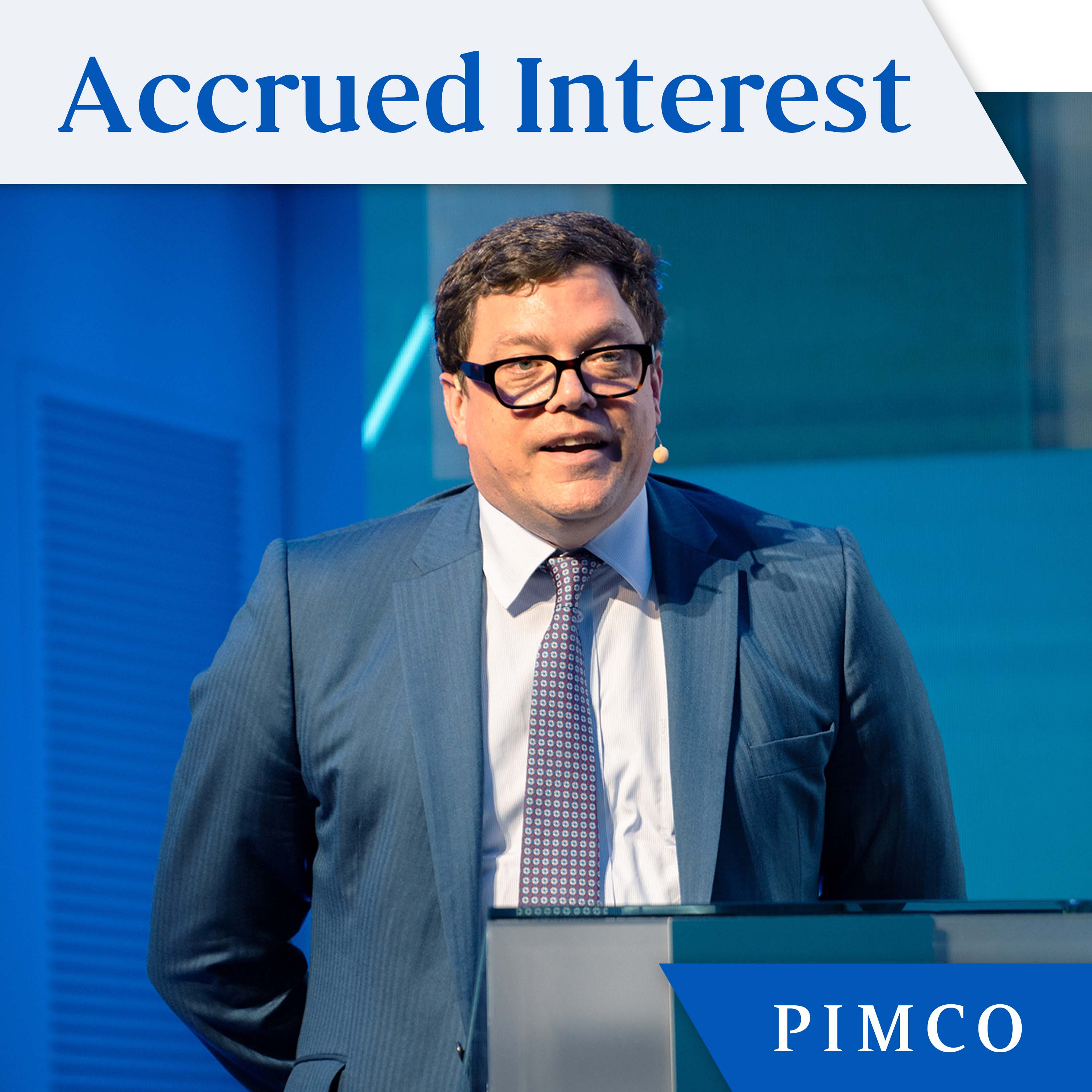
And today I'm really excited to be joined in our Newport Beach studio by Andrew Balls. Andrew is our CIO for Global Fixed Income. And the stars have aligned. We find ourselves both in the same place in Newport Beach. I'm usually in New York. He's usually in London, but here we are together today. Andrew, thank you for taking the time to join us.
ANDREW BALLS: Great. Good to be here. I actually thought you were gonna be in New York, so it's a nice surprise that we both here together.
GREG HALL: It's a little bonus. We can be that much more natural, and we don't have to do this over Zoom.
I've wanted to have you on the podcast for some time, and there may be two reasons for that. One is, we don't get to spend a lot of time together. You're over in London managing our investment operation there, my job has become quite domestic. My travels take me to St. Louis and Paducah, Kentucky, but not so much to London anymore.
So, we overlap at our investment forums, and every once in a while, get to share a few words, but we don't often get the chance to have in-depth conversations. So, this is a real treat for me.
And then secondly and, and maybe more important to those listening is, you know, we as a firm, really since the rate reset in 22, 23 have been talking about U.S. investors needing to look a little bit more globally to find investment ideas. And this whole idea that we're in an environment that is characterized by a little bit less global synchronization. And so, opportunities emerging in different geographies that create the opportunity for diversification and excess return.
And so, we've had Dan Ivascyn on the pod to talk about it. We've had Marc Seidner on the pod to talk about it. We've had a bunch of Americans talking about opportunities outside the U.S.
and now we get to consult a local expert, a true expert. So, thanks for coming to do that with us.
ANDREW BALLS: Okay. Well, great. Great. I think Dan and Marc are true experts as well.
GREG HALL: That's—well, you've got the accent, at the very least. And I think, if nothing else, that'll give you 20 or 30% additional credibility. Why don't you... You've had a really interesting road to being here at PIMCO, and I think the advisors listening would actually get a kick out of hearing how you came to be in your seat.
ANDREW BALLS: Ah, yeah. So, I joined 20 years ago here in Newport Beach. I was here for a few years, and then I moved to London after the Lehman crisis.
Before I joined PIMCO, I was at the Financial Times. I was a columnist and then an economics writer for the FT, covering the Federal Reserve in Washington, D.C. I was there for the last period with Alan Greenspan and the Bernanke transition. I also covered global economics for the FT. I got to know people at PIMCO well, and I joined here as a global strategist. I did that with our global desk here.
Then I started managing global portfolios, and a few years later I became head of our European team. Then, when we had our transition in 2014, I been the CIO for Global Fixed Income. A big part of my job is managing global bond funds and U.S. international bond funds. I work very closely with the team here in Newport Beach. I'm here quite a lot. And then, of course, I work with the team in Europe and in Asia. I also work closely with Pramol and the emerging markets team as well.
GREG HALL: Pramol is a recurring guest on the podcast. He and Marc are on each quarter talking about their PIMCO Perspectives piece, and they were actually our last couple of guests. It's not that common to see folks move from a journalistic role into managing money. What do you think it was about your experience? Or was there a piece that you wrote that got the attention of the folks here?
ANDREW BALLS: I knew the people. This seems like a long time ago now, but when I joined the firm, we had one or two people who looked at policy. Rich Clarida and I joined together to look at policy for PIMCO. It seems funny now because you had the 2018 government intervention across all of the markets. Now it feels like everybody looks at policy all the time. But back then, they wanted to strengthen the effort on policy.
So, I'd got to know the firm well, and I thought it might be a hard transition. On the first day I came in, I was presenting at the Investment Committee on what the Fed was going to do, and it wasn't. Half of the job is very similar to what I used to do. The other half is very different.
But you're spending time thinking about macro markets and central banks—that's all quite similar. Then the other part of the job, managing money and the mechanics of markets, is something that you learn on the job.
GREG HALL: Yeah, yeah. Well, let's talk about the mechanics of markets, and let's talk about managing money right now. Among your many responsibilities here at PIMCO, you author our or at least many of our Investment Forum pieces and listeners to the pod world recognize these as a thing we published four times a year after we have a large internal gathering three times a year, we write what is called our Cyclical Forum Outlook, which focuses on roughly a six-month time frame.
Then, once a year, we do a Secular Forum, where we try to attack the biggest themes in markets, things that we think will influence markets over the next five years and beyond.
Andrew co-authored the most recent piece, Rupture and Resilience. Among the thesis laid out in that piece was a prediction that, with a new Fed, with global desynchronization, we may encounter a bit more volatility than we been use to in global markets.
And that prediction seems to be coming true, at least over the short term here. Andrew, do you wanna maybe just level set U.S. on how you're thinking about the investment environment today? And particularly with a non-U.S. angle. Please talk about the U.S. from your perspective as well.
ANDREW BALLS: Sure. So, yeah, we think we're gonna have these repeated periods of volatility. So, we had interesting markets here in the U.S. last week. But we've had this across different countries. We've had this in the UK, in Japan. We've had this in Germany over the last year and a half.
I mean, I think part of this is, you know, starting conditions, high levels of debt. You can have periods of volatility. It may be that the markets are focusing on fiscal, it may be markets are focusing on, on the central bank, which seem to be more of the story here in the U.S. last week. And so, I think, you know, U.S. as active managers we need to be ready for this.
And, you know, there's, there's always good opportunities. We like volatility. We like occasions when you may see markets move a little bit away from the fundamentals.
And, you know, that gives us an opportunity to, to take the other side or to go along with it, depending on how we see the see the opportunity and then the, the secular outlook rupture and resilience.
I think part of this is, if you look back, so I was talking about when I started at, at, at the firm, I mean, a reasonable model for kind of policy analysis is assume that governments do the right thing. It may take a little bit of time to get there.
GREG HALL: Once they've exhausted all the other options. Yeah.
ANDREW BALLS: Exactly. And then, on the central banking side, assuming that you get to the right place, there may be a bit of a lag.
You may have institutional or bureaucratic reasons, but anticipate that path and then position for it. And so, the kind of the key organizing thing on the policy side would be the economics, drives the politics. And as we say in our outlook, I think that's turned it on its head in the U.S. quite prominently. But across the world, the politics is driving the economics.
And you see that in terms of the U.S. and you see this in terms of the president Trump's administration. But then you see this in other countries, if you look at globally at kind of government interventions, industrial policy kind of favoring domestic firms in procurement, all these kinds of things on the fiscal side as well.
And at PIMCO, we have a tradition of investing around public policy investing around government reaction functions. So, I think this is a good environment for U.S. as active managers. And then we're gonna have lots of global opportunities because these shocks, these challenges will have different impacts on different countries.
GREG HALL: Yeah, if I can interrupt, I wanna talk about that a little bit. I think I underestimate sometimes the amount of attention that U.S. financial advisors pay to overseas developments.
When I go do meetings in, throughout the country, I'm often pleasantly surprised by the degree of familiarity with what's going on in Japan, what's going on in the UK.
But for those who maybe are using this episode as a little bit of a catch up, I think it'd be really interesting to talk about the political developments in Japan that have caused a reshaping of the yield curve over there. Obviously, you in the UK have just lived through a political transition. So maybe we can kind of go into that and you can maybe illustrate what you mean by politics driving economics?
ANDREW BALLS: So, Japan is interesting. There's a prime minister who is quite radical in terms of his agenda—a kind of return to the Abenomics period. Again, the politics are very much driving the economics. They want to use fiscal policy.
And to use fiscal policy to support growth and to put pressure on the BOJ to keep interest rates low. Then this has run into another oil price shock that we're living through, and there's pressure here in terms of the system. We've seen yen intervention—we saw it last week, and we saw it earlier in the year.
GREG HALL: And that's the BOJ buying?
ANDREW BALLS: That is Ministry of Finance intervention. What we have there is the combination of fairly loose monetary policy, given the level of real yields, and fiscal expansion is currency-unfriendly, and the yen is at weak levels. We saw intervention last week to try to strengthen the yen.
Now, this is a complicated situation because you might think that if you want a stronger currency, then the central bank may just want to raise short-term interest rates more. But the BOJ left rates on hold last week. So, you have this inconsistency in terms of the system, and these are the kinds of policy interventions that don't really work.
If you come in and buy the yen, you can flush out short and you can have a short-term impact, but it doesn't tend to have a lasting impact. We saw intervention earlier in the year.
Now, a really interesting part of this occasion is that the U.S. did some intervention as well. They bought the Japanese yen late on Friday, and then they sold the euro, which is interesting because you might think they would sell the dollar. But I guess they didn't want to send too much of a signal there.
GREG HALL: Is that political in the U.S., do you think, as well?
ANDREW BALLS: I think it's a pretty confusing thing to do. It probably blunts the impact of coordinated intervention. But I guess the signal is that the yen should be stronger, just not necessarily against the U.S. dollar. I do think it blunts the impact of coordinated intervention. But why might the U.S. Treasury be interested in this joint intervention?
I think it speaks to the point you made about global factors impacting U.S. markets. The Japan curve has steepened a lot. The 30-year JGB has sold off significantly over the last year. The curve is very steep—the steepest among the G10.
I think there is a perception that this has an impact on yields at the long end of the U.S. curve. Maybe markets extrapolate the fact that Japanese investor, big holders of overseas assets, might reduce their holdings of overseas assets.
GREG HALL: They can bring money home and have some of the same return rates that they do overseas.
ANDREW BALLS: So, I think part of the angle for the U.S. Treasury is probably the belief, the feeling, that the steepening of the curve in Japan has put pressure on long-end rates in the U.S.
And so, you can do some currency intervention to strengthen the currency.
So, Japan's long end of the curve looks relatively attractive. There's enough risk premium there. You might combine that with being underweight in the two-year part of the curve, or the 10-year part of the curve, anticipating over time, short rates should be higher.
And this would lead to a flattening of the curve—some outperformance at the long end of the curve. The U.K.—we've had a change in terms of the prime minister. This is interesting from a bond market point of view. We'll have a budget in October, and there'll be a lot of focus on the fiscal plans of the government. They have a set of rules.
They've said that they will stick with the same rules as the previous finance minister, and the previous prime minister. But, this adds some uncertainty in terms of that market.
GREG HALL: And so the new Prime Minister, Andy Burnham, he leans a bit to the left. Yes?
ANDREW BALLS: He's a social democrat. He is pretty centrist. From a market's point of view, we will need to think about fiscal policy. Markets, the gilt market is sensitive to fiscal policy. The signals have all been, you know, pretty good actually.
But in terms of the risk premium, there is, you know, some potential for the markets to build more risk premium in the long end of the curve, like I just talked about in Japan. So, what we will tend to do in our portfolios there is to be positioned at the front end of the curve, the two-year, the five-year part of the curve. And, you know, this relates to global repricing since March.
There's a lot of risk premium in the front end of the curve across markets, given the oil price shock that we've had this year. The UK would be one of the, I think, most attractive front-end positions to have. So, I think it's a good opportunity for us. But for now, steer away from the longer end of the curve. And if we price in more risk premium over time, you know, may be a good opportunity later.
But I think it's important, you know, this is a—we talked about the global environment, the secular environment. It's a good environment for active managers. You know, choose the parts of the curve where you want to be exposed. In the UK, probably the two-year, not the 30-year. In Japan, the 30-year, not the two-year.
GREG HALL: Yeah. I noticed that as you were speaking.
ANDREW BALLS: And across the different markets, look to position for the most attractive opportunity. We don't need to just have exposure across the whole of the curve,
GREG HALL: Sort of isolate where you want to express your duration, both geographically and chronologically, or in terms of tenor.
ANDREW BALLS: In terms of the curve. Yeah.
GREG HALL: Yeah. And it seemed to me, I guess, you know, the way you set up the conversation was interesting. You know, we're starting from a position where there's a lot of debt in the world, and it feels—it's probably not the right term for it—but tight.
The markets won't really allow a lot of fiscal wiggle room or monetary policy wiggle room. They tend to react, or at least we've seen them react meaningfully and quickly over the last six, eight months almost, maybe in disbelief of fiscal discipline or fading the ability of governments to tone that down.
ANDREW BALLS: Yeah. I think that's right. So, I think when you look at over three to five years, you have not a lot of fiscal space across the G10 countries. You know, in the event of a shock, a demand shift in terms of the economy, you know, it's probably going to be monetary policy that needs to do more of the work, not fiscal.
Now the initial conditions in terms of the level of market interest rates provide that room. You know, we're well away from that period of zero interest rates, the zero bound. We were in negative interest rates in some countries. We're out of the period for the most part, quantitative easing, yield curve control.
So, in the event of a shock, it would be monetary policy that does the heavy lifting. So, we earn the yield that we earn on the funds. Again, you know, five to seven percent type yields look very attractive just in terms of the expected return. But in the event of a shock, in the event of a recession or an equity market correction, the potential for capital gains, given the scope for central banks to cut rates.
And then, in steady state, I think we've seen this in a number of markets. We saw a 30-basis point move one day in Germany last year. We saw a 30-basis point move in the long end of the UK one day last year.
We should just anticipate these periods of volatility, dislocation. You know, we can protect portfolios against that in terms of where we choose to position on the yield curve. And then we can look to benefit from this when you see good opportunities because you will have periods where market pricing moves away from the fundamentals.
And so, I think Japan would be a case. You do have excess risk premium in the long end of the curve. So being overweight the long end versus the 10-year or the two-year, say, should be a good trade over the next couple of years.
GREG HALL: What about the rest of Europe outside the UK?
ANDREW BALLS: So, Europe, again, one of the themes we have is less synchronized global cycles. The ECB has heightened interest rates this year. The U.S. has been on hold. The UK has been on hold. Pretty good chance—I mean, very good chance, actually—that we'll get another rate hike in September.
In the initial phases, Europe, a single-mandate central bank, not a dual mandate like the Federal Reserve. The impact of energy prices for energy-importing countries is particularly important. So, we started off with this shock, with Europe, the UK, the initial drivers. But then, you know, this is a global energy price shock.
You want to look at the impact across all countries. The U.S. is somewhat more protected by the fact it's energy sufficient. But, you know, Asia—most of the countries in Asia are going to be energy importers, not just Europe. The market initially priced this very much as a kind of a European shock, maybe looking back to 2022 when the energy price movements were Russia-Ukraine related, Russian gas related.
So, one thing we did in global portfolios was to look to add some European duration, some UK duration, when it sold off. And the other side of the relative value was to sell duration in Asia. So, Singapore was a good opportunity. And then over time, the market repriced yields higher globally.
So, the March shock, more driven by Europe, and then this broadening subsequently, including the U.S., although, you know, happier tale in the U.S. with AI and optimism around the AI CapEx cycle as a driver, whereas in the rest of the world, more the oil …
GREG HALL: Yeah. I wanted to ask you—I mean, wow, there's so many interesting topics. I wanted to ask you about the AI cycle in Europe versus the U.S. primarily. How do perceptions of that differ as a global spending and growth phenomenon?
And then, obviously, the way it lands in terms of the local fundamentals is very different in the UK and Europe than in the U.S. So, are you underwriting investments with sort of a thought that there's no benefit from the AI spending cycle in those parts of the world? Or is it more nuanced than that?
ANDREW BALLS: So, I'd say the AI cycle is something that has clearly been dominated by the U.S. and China. And then, you know, there's other countries in Asia—Korea, Taiwan—benefiting as well in terms of the supply of chips etc.
I think it is something which, over time, will be a positive in other countries. You'll have this AI CapEx cycle globally. I don't think it'll be to the same degree as we have here in the U.S. The benefits, in terms of the use of the technology, again, should be felt globally. I mean, the big thing which has been happening this year and last year has been the boost to U.S. growth.
And that's been very important. It's been a real stabilizer for the U.S. outperformance versus the rest of the world. And then the other thing has been issuance. So, the growth of issuance in the technology sector has been really large, driven by the U.S., but that will reprice global markets. And so, you know, …
GREG HALL: There's only so much global appetite for credit. And when the U.S. companies have a lot of issuances, it will suck demand, or it will widen spreads. Yeah. All things being equal, you know?
ANDREW BALLS: So, I mean, credit is a very global market. So, the increased issuance in the U.S., sucking in the capital, as you said, will have an impact…
GREG HALL: Maybe not as elegantly as I might have.
ANDREW BALLS: But it will have an impact on the global sector. We, you know, markets price credit in terms of the global sectors, you'll have issuance by U.S. companies in other jurisdictions. And it's really interesting because if you look back over the past, so you had the widening of spreads, this is very interesting 5,200 basis points of widening in terms of the U.S. tech sector, the growth of issuance is enormous.
We at PIMCO will be careful in terms of the generic exposure because there is a lot of issuances. But we will look to do good deals where we can get the economics that we want, where we can design the terms of the security to suit our needs.
So, you know, be careful on the generic stuff and look for the good bespoke opportunities. And we started earlier talking about rupture and resilience. I mean, you've had a lot of policy uncertainty coming from the US.
You had liberation day a year ago. You've had you know, lots of discussion on you know international investors, their exposure to the US. very, you know, overweight exposures to the US. But you've seen real stability in terms of these exposures. Not very much in terms of shifts in asset allocation, certainly really not that much in terms of hedging behavior, either.
GREG HALL: Meaning non-US investors in US Treasuries? Or just the market…
ANDREW BALLS: But also the whole equities. And the US Inc. And part of the reason why, you know, you had a lot of noise around Liberation Day but not a lot of changes in behavior is, from the international investor point of view, if you want to have exposure to AI, then you need to have exposure to the US equity market.
So I think that's been another interesting phenomenon over the past year. You've had the policy uncertainty, the rupture, the resilience. But then you've had this big stabilizing factor in terms of the performance of the US economy, the leadership in terms of AI.
GREG HALL: One of the themes that's more Europe-specific that folks have discussed as maybe its own, maybe not to the same extent as AI, but still an important growth driver, would be European rearmament, the need for Europe to spend more on defense, not just given geopolitical threats, but obviously the US taking a more reticent position in terms of extending its own shield over Western partners. How do you evaluate that, both macroeconomically as well as from a tactical perspective?
ANDREW BALLS: So I think it's real. I think that you will see growth in defense spending in Europe over the next, you know, five, 10 years. I think you need to be careful not to overdo it because I think that countries will drag their feet. There'll be long-term goals in terms of 3.5% defense spending, but not getting there super quickly in a number of cases.
But I do think it's real. I do think it's something which is important. And the key thing has been Germany, where you have had more of a shift in terms of Germany. And it's a combination of defense spending, but also infrastructure spending in Germany. The German economy had been in recession for a couple of years.
The government had had a very restrictive fiscal framework, and they loosened that. And so the main shift you're gonna see in Europe, I think, is Germany. This is interesting in a number of ways. It's interesting in terms of the relative value, in terms of German bunds versus other European sovereign markets. It should be interesting over time in terms of the yield curve in Europe.
You've actually got quite a flat yield curve, tends to flatten particularly in swaps when you look at the interest rate swaps, when you look at the European market. So I think positioning for longer-term curve steepening in Europe makes sense, and probably somewhat reduced premium for German bunds versus other markets.
So one thing that we have in our portfolios, particularly the European and global portfolios, is we're overweight Italy. You can pick up some extra income. Italy is a country where the fiscal framework, the debt levels are high, but the deficit is under control.
And so over the coming years, you should see a rise in German debt levels versus Italy, say, and you may well see some reduction in the premium that we've paid historically for German bunds over something like Italy or Spain. So that's a good opportunity there.
France is going somewhat in the other direction. Again, politics driving markets, politics driving economics. The French have high levels of deficits, elections coming up next year, which will lead to market uncertainty.
And if we get a lot more noise later this year and into next year around the French elections, you know, that's good option value. In the baseline, I'm not sure we'll see a huge move in terms of the spread, but there's definitely the potential for the markets to price in more fiscal or more political risk premium in France. And so I think that's a good position to have.
GREG HALL: Yeah. It's interesting, the variety of positioning you can create in ostensibly connected but quite different economies. I wonder, on the security theme, one of the things I'd wanted to ask you is about perceptions of the Iran conflict, and not necessarily moral or political perceptions of it necessarily, but more, you know, are there viewpoints amongst the folks you speak to in Europe about that conflict, its potential for resolution, its long-term impact on the energy ecosystem globally?
Are there European viewpoints on that by virtue of maybe having Russia as a difficult energy partner over many decades, you know, that you think US investors ought to hear more of about how things might end up?
ANDREW BALLS: I think the way I would think about that more is probably, I think that—and we say this actually in terms of our secular outlook—energy could well remain an important driver in markets over the next three to five years. Thinking about winners and losers is important. And that may be at the national level, you know, countries where they are relying on energy imports.
You can see different outcomes, different risk profiles compared with those which are more energy-efficient. And I think that you can do that across G10. And you can certainly look across emerging markets at winners and losers in an environment of more pressure from commodity markets.
Just as, you know, there are other factors. We talked about AI. You're gonna wanna look at winners and losers across countries, but very much across sectors, across companies there. So I think that would be the main thing. You know, there'll be different political views in terms of the current situation.
But from a market point of view, I think pricing the energy impacts across countries, across sectors, and just being aware that, you know, this could well be a recurring theme over the next several years.
GREG HALL: What if you put yourself in the shoes of a US financial advisor? That's sort of an unfair question, like, "Hey, Andrew, justify what you do for a living." But from the point of view of a financial advisor in the US, how would you make the case for greater involvement in international markets? What do you think it can add to a more domestically focused portfolio?
ANDREW BALLS: I think in a fixed income portfolio, the first thing is the yields are attractive. So if you look at international bonds versus the US, as a hedged investor, you're getting very similar yields, slightly higher yields on the international side. So that's important.
So there's not a give-up in terms of the yield that you earn when you hedge the currency risk. If you have unhedged currency exposure, it looks a little bit different. I think for the most part with financial advisors, there's gonna be a clear focus,
GREG HALL: Typically a dollar preference. Yeah.
ANDREW BALLS: Because there's no particular reason to have the unhedged exposure. You may have some asset allocation reason, but the hedged yields are very attractive. And I think the main thing to understand is the attractiveness of the hedged yields. The second thing to understand is we think there's real benefits of diversification over time.
Your return per unit of volatility, or return per unit of risk, looks attractive when you have global exposure. Because in any one year, you will have different performance across different bond markets. And when you look over time, you may just get superior return, risk-adjusted return.
I'd say that's more compelling when you are comparing global or international with some of the smaller markets. So the US is a very large, diversified market itself.
So I think this is not as compelling in the US case, but still the numbers speak for themselves. And then the third thing, I think, and particularly in this environment, there's good global alpha opportunity set. And you can do this by having exposure to international or global bond funds. But you also can do this, you know, at PIMCO, of course, when we have good ideas, we'll do this across the complex.
So in our strategies, making good use of the international opportunity set on the G10 side, on the EM side, again, to have the benefits of diversification and then the benefits in terms of the alpha opportunities.
So, good environment for active managers. I always think, you know, there was this kind of dull period in the 2010s when yields were lower, volatility was suppressed. You had central banks suppressing volatility, high correlation across markets. There wasn't the same opportunity set. I think today, and going forward, benefit from the global opportunities, benefit from the volatility.
Look to have portfolios which protect you against the downside risk, but look to exploit the opportunities. And if we have less synchronized cycles, if we have greater differentiation across markets, that should be good in terms of active management.
GREG HALL: Yeah. And that's right. And I think you've helped us do a couple of things today. One is explain how diversification within the fixed income portfolio can enhance it and maybe decrease risk, maybe enhance return. But also you've laid out a pretty strong case for just fixed income generally.
I would say by far the most prevalent theme amongst fixed income investing in US financial advisors has just been the really unprecedented success of their equity portfolios over the last 10 or 15 years, and the degree to which that has squeezed asset allocation. So 60/40 is so far in the rearview mirror, we're at 90/10, maybe 85/15 if somebody's very conservative.
So articulating, I think, the case for taking advantage of some of these higher yields. And knowing that that spans markets, it's not just limited to the US, is important.
ANDREW BALLS: Yeah. And I think Marc Seidner would've said this when he was on the podcast, I bet, because he said it on other occasions, and Pramol and others. But I think to make a positive case for fixed income, I don't need to make a negative case on equity.
GREG HALL: He did, yes.
ANDREW BALLS: But if I'm earning 6–7% yield on the portfolio, depending on what your assumptions are for your equity part of the portfolio, the 6–7% yield for fixed income looks pretty good. I mean, it looks like equity-like returns.
Again, I'm not moaning about higher levels of government debt. They're part of the reason why we get these yield levels today. So we should benefit from that. And then in an environment where you do have a bump in the road in terms of the economy or equity markets, you've got the potential for outperformance, you know, double-digit returns. But just looking at the yields of the funds, if you get 6–7% type yields, that's a good guide to your expected return. And you don't need the central bank to cut rates, you don't need a recession.
GREG HALL: Andrew, you're familiar with the TikTok phenomenon of "6-7," right?
ANDREW BALLS: Six-seven? Okay. I do know what that is, actually.
GREG HALL: Yeah. I just thought you might be baiting me a little bit with the...
ANDREW BALLS: The reason—the previous UK Prime Minister did this in a school visit and got told off by the teacher, saying, "We don't do that in class."
GREG HALL: The previous Prime Minister?
ANDREW BALLS: No, but I thought it was a nice moment, actually. Six-seven. Five, six, seven.
GREG HALL: I think this is a good point maybe to end the discussion on a fun note. But it's been such a pleasure to have you with us. Thank you so much for everything you do on behalf of PIMCO and its clients. Thanks for taking some time today to help us bring some context and color to what you do globally for investors here in the US.
For those of you listening, if anything today captured your fascination, your imagination, your interest, please visit us at pimco.com in the US, or if you're listening in another country, you can visit our local website there. If you identify yourself as a financial advisor, you'll be taken to Advisor Forum.
That is our one-stop destination for you to find what you need quickly and efficiently from PIMCO so that you can digest the information, think about it, and then go on to having meaningful conversations with your clients.
Andrew, it's been a pleasure having you, and we'll look to do this again hopefully next year and make you a recurring guest. But with that, we'll see you all next time. And don't forget to like and subscribe to the podcast. If you let us know you're out there, it'll help us bring you more and better content like, hopefully, we have today.
ANDREW BALLS: Thank you for having me. Great to join.
GREG HALL: Alright.
From This Episode
- Why different parts of the yield curve look attractive in different markets, and how active management can isolate duration by country and by tenor
- Why fixed income can serve as both a diversifier to offset volatility and a source of alpha
- What AI dominance in the U.S. and China, German defense spending, and other country-specific shifts mean for global bonds
Show notes:
[9:59] The thesis of Rupture and Resilience
[15:43] Politics driving economics in Japan, the U.K., and Europe
[30:47] The AI supercycle in Europe vs. the U.S.
[36:13] The investment implications of rearming Europe
[40:51] Europe and the global energy complex
If you enjoyed the episode, check out more of our resources on global fixed income:


