




Please stay tuned after the conclusion of the podcast for additional important information.
GREG HALL: Hey everybody, welcome to another episode of Accrued Interest, PIMCO's podcast dedicated to serving financial advisors and their clients. I'm Greg Hall, I'll be your host. I lead the wealth management business for PIMCO here in the United States. Today's topic is asset-based finance. It's the other part of private credit. It is not captured as many headlines as direct lending in the recent past, but it still deserves your attention.
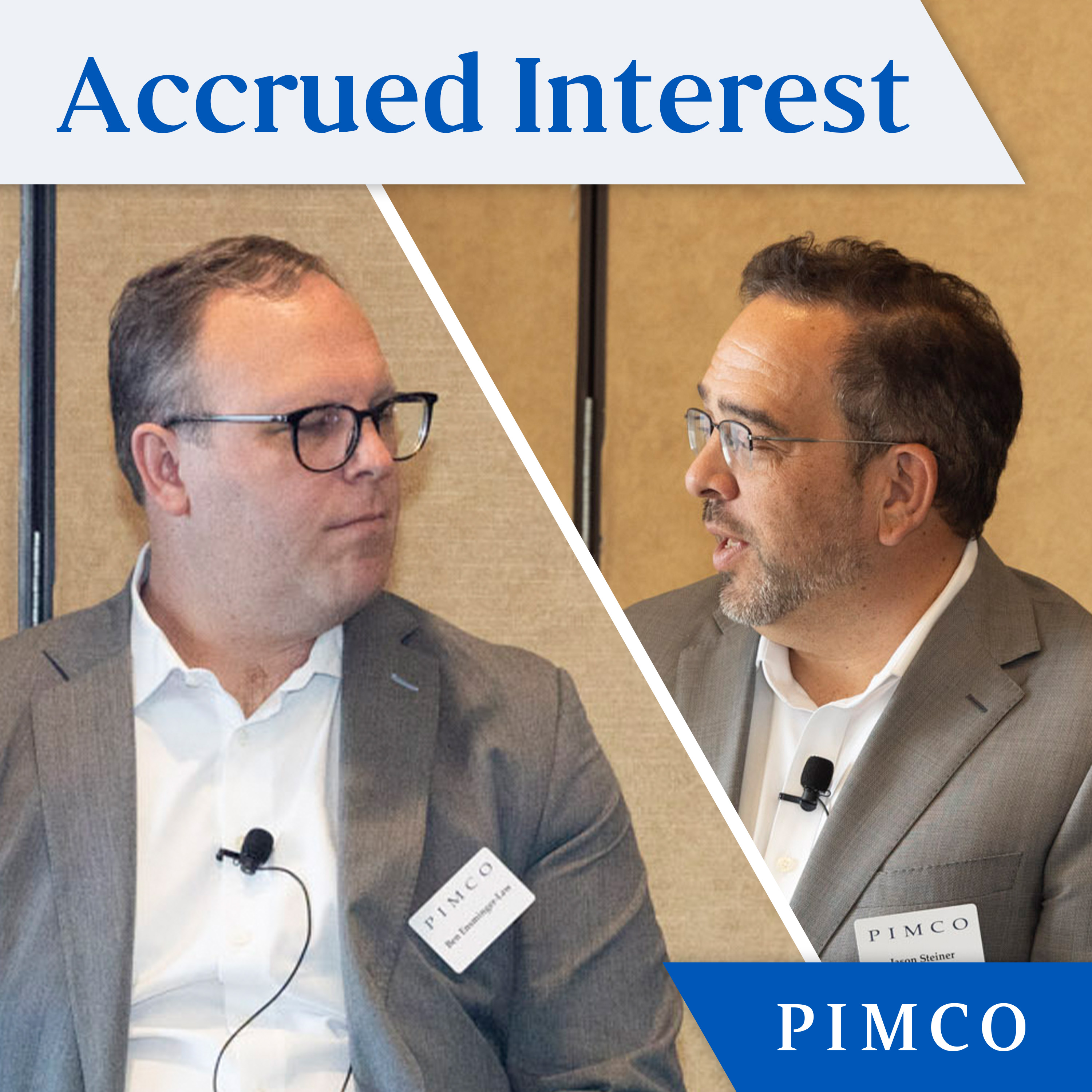
The last time we talked about, this was about a year ago with my partner and colleague Kris Kraus, and today I am lucky enough to have with me here in the studio, Jason Steiner, managing director here at PIMCO, and Ben Ensminger-Law also a managing director and here with me in the New York office, as opposed to Jason, who's in Newport Beach.
Why don't you guys just spend a couple of minutes each just talking about your roles here at PIMCO, your journey to get here. Jason, I'll let you go first.
JASON STEINER: Sure. Thanks. Yeah, so I mean, I've been at the firm going back to 2008. So I was brought on right at the onset of both the financial crisis and PIMCO's first foray into, you know, private markets. Prior to joining PIMCO, I worked on the sell side for a French bank structuring and then trading, you know, legacy subprime securities.
And so I was brought in, you know, to help kind of build the business on the private side particularly as it relates to, at the time investing in opportunistic and distressed mortgages. That platform evolved over the course of the last, you know, 18 years almost now. And, you know, is moved into, you know, a more of a parallel analog with some of our private side business.
You know, more about income orientated focused strategies in the private markets. The mortgage market obviously is a strength of health and resiliency. We could touch on that today. And so my role has really been, you know, moving where the opportunity set you know, is the best fit for both our clients and our capital.
GREG HALL: Yeah, it's pretty well documented. I think you know, PIMCO at the time, sort of leading into the financial crisis had a fairly dim view of what was going on in the mortgage backed security market as it related to non-prime origination. And you got here, just as I think, you know, the firm began to look through a lot of the securitized structures, the mortgage backed securities, and then began to acquire loans outright. So actually purchasing the assets that underlay the securities that had made up most of the market prior to that. Is that right, Jason?
JASON STEINER: Yeah, that's right. Right. I mean, again, we had, and continue to have a huge presence in the securitized products market, particularly in RMBS. But it was such a source of alpha for so many of our strategies that, you know, we had to find ways to take advantage of that. Those fundamentals beyond just was available to us in the securitized products market and investing in loans, you know, became a great opportunity. I know it'll be a theme that we'll touch on quite a bit, I hope today, which is, you know, balance sheet arbitrage and trying to take advantage of moving into places where others are moving out of.
GREG HALL: Yeah. Okay. Good. We'll put a pin in that theme. That's a good theme. Ben, you're a more recent addition to the PIMCO team.
BEN ENSMINGER-LAW: Yeah, I'm a newbie. I've only been here eight years now. I started my career on the sell side similar to Jason in kind of a variety of structuring and trading roles focused on asset based finance, or specialty finance as I still call it. And then I moved to a hedge fund and I was there for four years and then came over to PIMCO scant eight years ago.
GREG HALL: Scant. Yeah. No, I mean, I've been here for nine years and I still feel like I'm figuring out where things are. So it's, join the club, but you know, that's what happens when you work with mostly people who've been together for decades and decades and decades. Well, the topic for today's conversation is asset-based finance, and we last talked about this on the pod about a year ago.
When we did that podcast, we were introducing the topic of asset-based finance you know, for our listeners, for a lot of them, because the world was still very much in love with direct lending.
And I think, you know, probably looking at things then relatively unaware that it might need or want a diversifier away from direct lending. And we fast forward to today and the world is very much not in love with direct lending to say the least. And I worry that, you know, at the time, direct lending seemingly solved everybody's needs, so they were less interested in asset-based finance.
And today there's so much fear and I think there's a little bit of, kind of, you know, tarring a lot of different asset classes with the same brush that we also run a risk of not paying enough attention to what's a really, really large part of the private credit market. So I wanted to have you guys on and make sure that we put something out there that people can rely on maybe in the current moment or maybe as they look to sort of come back to allocation decisions over the course of the next few months as some of the noise in the market dies down and they're rethinking what they want to do to redeploy assets.
So, let me, none of this is a question. Let me, <laugh>, get to some questions. So, one of the things that I just wanted to kick off with was when Kris was on a year ago he used some pretty big numbers. He described the asset based market as about a $20 trillion market, and he listed a bunch of different asset classes that we're involved in or other market participants are involved in.
How are you guys feeling about that market today? What's interesting to you? What's maybe not, how has it evolved in the years since last we spoke about it? And I'll let, Ben, why don't you jump in on it.
BEN ENSMINGER-LAW: Sure. I'll kick it off. I mean, I think in some ways, you know, obviously it's a very different market, as you say today but there are a lot of similarities as well, right? So I think the drivers of desire for diversification within private credit still remain. I think a recognition that the kind of opportunities within consumer assets within resi mortgage credit, within equipment finance, commercial aviation finance, a lot of the verticals that we spend time and traffic in you know, still remains quite compelling.
It's obviously a dynamic market. So, you know, even three or four months ago, we wouldn't have anticipated necessarily all of the dislocation in oil and gas markets. That's obviously created pressure in commercial aviation, for example. And so I think that's an area that we're looking at right now, both as an opportunity, because there are a bunch of very good businesses that continue to need to finance their purchases from the OEMs of new commercial aircraft.
But it's also a threat. I mean, 30% of the input cost for most airlines is fuel. And fuel is significantly higher. And so, you know, I think a lot of the kind of core fundamentals that Kris hit on a year ago remain true. But, you know, it is obviously a dynamic and actively changing market.
GREG HALL: I mean, just to, you know, I probably should have done this at the top, but to sort of differentiate this market and remind listeners when we say asset based finance, let's differentiate that from middle market direct lending, which most people, I unfortunately that's become kind of synonymous with private credit. So Jason, maybe just walk us through, when we say asset-based finance, what exactly are we talking about?
JASON STEINER: Yeah, sure. So, I mean, I think the simplest way to kind of characterize it is that we're really talking about any lending in the private markets that occurs outside of corporate and CRE. So it's a little bit of a catchall.
GREG HALL: CRE being commercial real estate. Yes. So if you say an acronym, I will jump in and so just be aware.
JASON STEINER: Yeah, no problem. So what we're talking about outside of, you know, acronyms like CRE, is things like hard assets, financial assets, consumer related assets, and then residential lending. And, you know, these are assets that are, you know, typically secured by, so there are loans that are typically secured by assets like houses or aircraft leases or they're backed by contractual cash flows like, you know, in the case of an intellectual property or royalty streams or things like that.
GREG HALL: Makes sense. And I think, the, you know, the size of the market, what Kris sized it at 20 trillion, that has a lot to do with just, I think the sheer variety of what's out there. I would imagine, Jason, the residential market forms a pretty significant part of the overall pool.
JASON STEINER: Yeah. And again, if you look at the residential housing market just in the United States alone, right. The asset class itself is about, you know, $12 trillion market. Now, not all of that's private. Obviously a lot of that is agency mortgage debt but a $12 trillion asset class that's supported by almost a 40 or $50 trillion, you know, housing market.
So when you just talk about, you know, the size of the debt markets that are outstanding, it's very unusual to find something that in aggregate is as unlevered as a housing market. And that starts to form a foundation, not just for lending into residential mortgage lending, but looking for ancillary investments where the consumers will benefit from the amount of, you know, implied equity that's in their homes if they need to draw on it to pay down other forms of debt.
GREG HALL: Yeah, yeah. Lots of different flavors of how you use a valuable asset to, you know, create liquidity through borrowing. I'm curious, in your minds, how is the fund management opportunity here, how has that developed or evolved since the financial crisis? I think people, advisors listening will have heard many, many times and will understand, I think, pretty instinctively that after the financial crisis, banks had to pull back aggressively from corporate lending.
And that created the opportunity for private credit lenders to step in and finance PE sponsors who were doing deals. I think it's a little trickier when you're talking about such a huge variety of asset classes, whether it's aviation or credit cards, personal loans, autofinance, what, you know, all the different things that you guys look at. Is there a similar kind of underlying theme that's created a gap for capital in this space?
BEN ENSMINGER-LAW: Yeah, absolutely. I mean, I think that a lot of the dynamics that you're describing impacting corporate credit are at play in asset-based lending as well. I think they've taken a little bit longer to play out. And we've seen more recently some kind of acceleration in those longer term trends. Some of that came about when rates sold off dramatically. And banks' kind of asset liability mismatch was, you know, highlighted particularly in some of the larger duration.
GREG HALL: This was back in 2022. And obviously we had First Republic and a few other banks encounter really, really, really difficult times given their, the way they'd structured their balance sheets and their interest rate exposure.
BEN ENSMINGER-LAW: That's right. And you know, we talk about bank dislocation and disintermediation. I think these are parts of a longer term trend that have really been occurring since the financial crisis. But there are these periods of acceleration. So we saw that in, you know, 21, 22. We've seen it more recently because of some in the US accounting rule changes that make it more costly for public gap filers to hold longer credit duration assets.
And I think all of those things are creating, frankly, a more balanced lending market where, similar to the corporate side, you have insurance companies, asset managers, kind of non-bank participating alongside banks. I mean, banks continue to play a meaningful role in these markets.
GREG HALL: And it's not the trend, it's not just banks, right. I mean, I think there's also been a long trend of businesses that found themselves in the financing business because you know, you sell jet engines and you then offer a finance your customers’ purchase of those jet engines. And the next thing you know, you've got billions and billions of dollars of loans on the balance sheet.
And the equity market's questioning why it pays you a big multiple on earnings relative to what it might pay a bank if you're a, I remember retailers, you know, you used to have huge credit card programs 'cause it's easier to sell a refrigerator when you can get your first 30 days of interest free and put it on the card. And so I think you've seen those guys all back away as the equity markets become more assertive about applying higher valuations to smaller balance sheets. That's a simplistic way to say it, but…
BEN ENSMINGER-LAW: Yeah, I mean, you go ahead Jason.
JASON STEINER: I was gonna say, yeah, I mean, this is obviously not new Greg, right? Like you look at even, you know, home builders for example, right. That used to own a lot of land on their balance sheet and no longer do, right. So when the equity markets are trying to solve for, you know, maximizing enterprise value, right? They can, you could see big shifts in the balance sheet from a capital heavy model to a capital light model.
And you know, the way that I think we try to think about things is, you know, when you're trying to earn a spread over kind of the risk-free rate, how much of that spread that you're earning is, you know, the liquidity that you're providing to the counterparty, right?
And if you can maximize the spread that you're earning coming from both liquidity and somewhat complexity as opposed to kind of directional credit risk where you may be wrong, if you're wrong about the future state of the markets, right? You're gonna have more stable returns, more stable outcomes and hopefully have, you know, the opportunity to, you know, maximize returns in most states of the world.
GREG HALL: So Jason, just to really quickly restate what I think I'm hearing you saying is, you know, what we're looking to do in this area is by rolling up our sleeves, understanding things that are really difficult for the market to interpret and getting paid for being able to kind of get into that complexity, trying to avoid situations where the market correctly interprets that there's a real risk of nonpayment. And so rates are appropriately quite high.
JASON STEINER: Yeah, that's right. I mean, I think the important thing about a lot of these markets, right, is that, you know, to your point about payments, right, cashflow velocity, right, is a feature of the asset class, right? We know when our borrowers are paying because the borrowers make payments every month, and you could see how credit performance is holding up or if it's deteriorating in real time, right?
That in and of itself is also so much different than some of the dynamics that we've seen recently in the direct lending markets where you know, maybe payment frequencies are less frequent, you know, quarterly or semi-annual, but also because of the kind of, you know, the increase in things like pick interest, right? Sometimes borrowers aren't making any payments at all. And then how do you know whether or not they're actually able to, or in some cases, willing to make those debt service payments?
GREG HALL: Yeah. Well, I think that, I mean, that sort of points to, I kind of wanted to ask this question of you guys early on as well. I think that, what that points to is the difference between a market where there's maybe too much capital chasing too few opportunities. And so the lenders are willing to make concessions, like, actually, you don't have to pay me interest for a while.
Why don't, you know, let's see what happens and we can add that to the tab. Whereas in the markets that you guys focus on, I think you would argue that we don't yet have that dynamic that you're able to pick and choose amongst a lot of different opportunities. And you don't really feel the need to concede terms at this point. Is that, I know there's a lot of different markets that you operate in, but as a general statement.
BEN ENSMINGER-LAW: Yeah, I think that's a fair statement. I mean, I think that, you know, in many ways, I think that our markets overall are analogous to where kind of middle market corporate credit was 10, 12 years ago, right? Kind of early stages of a transition from a prime predominantly bank driven market to a more balanced market, including, you know, obviously having involvement of asset managers. And at that point in time you had the ability to drive terms, drive incremental spread.
I think the key difference as we've kind of noted here is the size of the addressable market is significantly larger, right? Probably close to four or five times the size. And, you know, where we are from a capital creation perspective is, you know, really the infancy relative to middle market corporate credit, or even relative to the size of the addressable market.
GREG HALL: Yeah. And I think, and this is something that as we've talked about this in the past, I think you're both really focused on as well. We tried to be responsible on the podcast and the, we had a conversation with Lotfi Karoui, who is Chief credit strategist here at PIMCO and co-head of our client solutions and analytics area.
And every time we talk about this topic and private credit, I think we try to point out to advisors listening that you'll never hear us argue that we've discovered some magical new form of lending that is not economically sensitive, that isn't subject to too much capital, chasing too few opportunities. We will argue in this case that right now on balance the opportunities favor lenders and to the extent that that's cyclical and that it changes, they should look to us to let them know.
JASON STEINER: Yeah. I think, again, obviously starting conditions matter quite a bit, correct, right? So if we look at where we are in the market, again, we're supported by, you know, relatively strong fundamentals across some segments of the consumer markets and also the asset class itself, right? Allows for, you know, flexibility if, you know, the clients will allow us that flexibility within the mandates. So, you know, if you look, what I mean is, right, diversity is kind of like a feature of the strategy and not a book, right?
We want to have the ability to invest across multiple asset classes and to pivot across, you know, certain asset classes within this subsequent of the market because relative value might change, right? And fundamentals might change.
And, you know, if you compare this even, you know, to the recent history of asset-based finance, if you go back to just 2020, 2021, when interest rates were low, when people were talking about asset based finance, or at the time they're talking about specialty finance lending, they were talking about, you know, largely uncorrelated asset classes that are relatively small, but traded at high yields in a very low interest rate environment, right?
And what I think Ben was talking about with kind of broad asset classes, right? That's really kind of what we call the wide swim lanes of the asset based finance market. Again, things like mortgages, consumer debt, aviation leasing, you know, markets that could be hundreds of billions of dollars or trillions of dollars, right?
As opposed to, you know, diversifiers in a portfolio that might be, you know, a $10 billion market or a $5 billion market where it's hard to run a strategy dedicated just to a single asset class in that size of the market where the risks of overheating, the risks of, you know, chasing yield are just more exaggerated given the size of that market versus, you know, the overall aggregate as raise finance market today.
GREG HALL: Yeah. I, so this brings up a couple of questions just that are pretty fundamental to this part of the market. I guess the first one, Jason, you said that some elements of the consumer economy are doing well, let's talk about that, 'cause I think for almost everything we've talked about maybe not equipment finance and rail, you know, but for almost everything we've talked about, you need to have some belief that consumers are gonna pay their bills.
The journal ran an article this past weekend talking about how all the private credit guys are getting into credit cards, you know, and the implication being, of course, that they're taking excessive risk. But let's just let's take that at face value and, you know, how are you thinking about consumers? How are we picking our way through the very large kind of consumer economy here in the US? Maybe Jason, from your perspective, and we talk about Ben's feelings as well.
JASON STEINER: Yeah, man, I think the first point, you know, is something I kind of highlighted earlier, which is, you know, it's hard to ignore the consumer asset class without talking about the mortgage, right? The mortgage market is, you know, a huge portion of the overall consumer finance industry. And mortgages and the housing market, by and large, sit on pretty stable footing, right? We have the benefit of a lot of home equity.
Most borrowers in this country also have the benefit of having locked into very low interest rates during the time period of 2020, 2021. So the tailwinds of rising interest rates did not hit the consumer in the same way that it hit, you know, markets like commercial real estate lending or even parts of the direct lending markets, which are floating rate debt markets. That's provided a long-term tailwind.
There's also a high correlation between homeownership and, you know, Americans or consumers that own stock portfolios. And obviously the equity markets have also had, you know, a pretty long run of, you know, mid-teens, double digit type returns. And that's been a secondary first form of wealth creation. So when we talk about some portions of the consumer markets, right, it starts with home ownership. It starts with, you know, Americans at the high end of the income spectrum.
Oh, and by the way, right, that's a part of the market that really since you know, since Silicon Valley Bank, since First Republic has been a portion of the consumer debt markets that the banks have been forced to step away from. Everybody sees that coming back. But that's been a lack of capital. So spreads have been wider than fundamentals would otherwise dictate. That should be, because there hasn't been as much of a balance sheet available to that portion of the consumer market.
GREG HALL: It implicitly though, it sounds like we are focusing on an upper echelon that you are probably less interested in expanding downward in credit quality in search for yield and rather maybe focusing a little bit more on getting paid and a little bit less on, you know, the absolute nominal, you know, spread that you can achieve in making these loans.
BEN ENSMINGER-LAW: Yeah, that's exactly right. I mean, I think, you know, there's obviously been much discussion of the K economy, the K-shaped economy. And we've seen that in the…
GREG HALL: It's hard on a podcast to visualize the K with its two legs kind of kicking in different directions. But the idea being obviously that some portions of the economy are doing great and some portions of the economy are not, it would, it's income inequality. It's all of the above, right?
BEN ENSMINGER-LAW: It's the impact of inflation. It's all of that. And we've seen that in the consumer performance data. And to your point, I mean, that has generally kind of resulted in us being up in credit quality biased for the last couple of years. And having a view that, you know, the subprime portions of the market don't provide adequate compensation net of expected charge offs and adjusted for the potential standard deviation of those charge offs. Now, there may come a point in time when that's no longer the case, right?
I think generally what you've seen historically is the subprime opportunity set becomes much more attractive in, you know, emerging from a recessionary environment rather than, you know, in a performing or potentially kind of worsening credit environment.
GREG HALL: Sure, sure. And late in the cycle is when I think we'd all agree those, that's when mistakes tend to be made. The other thing you, you sort of alluded to Jason, was some of these more narrow asset types that are, sometimes it's difficult to run a product dedicated to that because it's just the old proverb of, you know, if you're a hammer, you're always looking for a nail, right? It's really hard to know if your market has become unattractive if all you look at is your market.
And so comparing across a lot of different verticals is really healthy. But how do you guys think about origination of assets in that context? 'cause we can't be everywhere. You know, we have a big team, we have a huge platform. But as you think about some of these different market niches, how do we access those? How do we think about partnering with folks in those spaces? Just walk us through our philosophy there.
JASON STEINER: I mean, I think one of the things really, you know, drives, you know, our investing style is, you know, I think about, you know, cashflow investing as opposed to asset class investing, right? And so when we look at, you know, asset-based finance markets, broadly speaking one of the features that, you know, we like in this asset class is that there's a number of asset classes within that market that sit at kind of the short end of the kind of weighted average life or short end of the, of the yield curve.
But, and at which, you know, given the shape of the yield curve and given the shape of, you know, I guess the relative flatness of the curves of egg you can actually get paid, you know, for being short. But also it gives a benefit of having, you know, this high cashflow velocity where borrowers, you know, take out a five year loan, but over the course of, you know, a two year weighted average life, you're gonna get back your money because they're gonna pay principal and interest over a time period.
Now where we choose to deploy capital within that short weighted average life of the portfolio, it might be in things like unsecured consumer credit, if, you know, we have a view that you know, that we've come out of a downturn going into a more benign credit environment. It might be in things like, you know, more hard asset backed things like auto loans or motorcycle loans.
If we’re looking for a harder asset backed protection such as, you know, we're looking for today. And so when you start thinking about things, about cashflow perspective, then it allows you for the substitution effect of different asset classes across a broad opportunity set. Now, again, we have the benefit, Ben and I both of being at, obviously Greg, you're here at PIMCO as well.
Well, but on the investing side, being at the PIMCO where we have a huge portfolio management team that could go out and source assets across all these opportunities. And so that's the real, you know, one of the real powers and differentiators that we have is that, you know, we can look for asset classes that, you know, might only be a 20 basis point portion of a portfolio. But we can scale it up if we're looking to, you know, move into that as a replacement for another asset class that looks less attractive over time.
BEN ENSMINGER-LAW: I think it also, you know, you had mentioned kind of origination in the front end. You know, there are a bunch of different ways that we look at originating. We do in certain instances own origination platforms. But I think that we take a very balanced approach to how we originate loans. It is through direct originator relationships, so longstanding relationships with originators.
It's through JVs, it's through owned origination platforms. And I think you need to have the ability to look at all of those as potential sources of flow because there isn't a right answer, right? There are pluses and minuses to all of them. You know, I think that even in instances where we don't have an economic interest in the originator, which is where most of our flow comes from.
We try to be, to provide a price, we try to be a consistent buyer. We will not always be a buyer at a price that the seller wants to sell. But we'll be a consistent capital partner. And if you think about, you know, if you were running an origination business, access to capital is the lifeblood of that business.
And so even during periods of time like COVID, when there was a lot of uncertainty, you know, I think we generated a lot of goodwill with our originator partners by showing up and continuing to be an available source of capital, albeit at prices that reflected a much, much higher expected charge off rate or net loss or whatever metric you want to use.
GREG HALL: We hear in this space of the market, the phrase origination is alpha. I'm curious if you guys agree with that assertion?
BEN ENSMINGER-LAW: I don't, I think that it is a source of alpha, you know, when I think about building an ABF business or what are the requisites to successfully investing in this space, it basically comes down to four things. Origination is one of them. So access to the whole loan flow. It's important. Underwriting is the second one, you know, every bit as important as your ability to source the loans is your ability to correctly underwrite and model the expected loss. Financing, right, is a, also a non-real <inaudible> one. Particularly in kind of private funds, we're mostly getting leverage on whole loan pools.
GREG HALL: Right, so this is our, the leverage we access to sit underneath our, or sit on top of our client's assets so that they earn a leveraged rate of return on their investment.
BEN ENSMINGER-LAW: That's exactly right. And so, you know, when we can create more efficient mechanisms to leverage these assets, that accrues directly to the benefit of our clients, right? Either through higher returns or through lower risk per unit of return.
GREG HALL: Absolutely.
BEN ENSMINGER-LAW: And so I think that is a key alpha generator as well. And then the last is these are operationally intensive businesses, right? This is not a static portfolio. This is not, you make a loan and then five years later you get repaid, And in the interim, all you do is book coupons, right? These are living, breathing portfolios.
They are dynamic, they're actively servicers that take different approaches which have different outcomes. You need to be very proactively engaged with your servicing partners, managing KPIs around servicing, pushing down best practices and ensuring that everybody is doing the right thing to drive outcomes. You need to be able to switch servicers if you need to. You need to be able to, you know, periodically have audit rights, ensure that there's not, you know, double pledging or you know, there's obviously been some kind of…
GREG HALL: Yeah, I wanna talk about that. Absolutely.
BEN ENSMINGER-LAW: Some big headlines associated with some of these. And I think that's another leg that's important. So when I talk to investors, I try to highlight kind of these four areas are the areas they should be really focused on, because I think if you don't have all four of them, you probably shouldn't be investing in these assets.
GREG HALL: It's an interesting question then. So yeah, I mean I of course agree with you on all of those points. The thing that I think is interesting about asset-based finance relative to the direct lending market is something that Jason started to get into a little bit earlier, which is the pace of amortization of a lot of these assets is faster.
And so you may see, you know, you may, you start getting principle back almost from payment one depending on what we're talking about. And so how do you think about, in some of these portfolios that are predominantly private loans, how do you guys think about adjusting that as your own views on relative value change? And how do you think that balance between liquidity and then the opportunity cost? And maybe Jason, since you started talking about it earlier, get your thoughts on that.
JASON STEINER: I mean, again, I think, you know, what's gonna drive that decision is gonna be, you know, one our view on, you know, whether or not we think we can, and whether or not we want to continue to source assets within that part of the market. You know, I talked a little bit about, kind of this idea of, you know, being on the short end of the curve, right? In certain markets, maybe that doesn't make very sense, makes a lot of sense, right?
If the yield curve was very steep, if short end rates were, you know, one or 2% and you know, maybe we'd have a different view. But, you know, we want that ability today to invest maybe 30% of our assets in something that's like kind of two years in end, right?
That's gonna give us the ability to, you know, to make that relative value decision about whether we wanna go out on the curve as the investment environment changes, as the yield curve changes, as fundamentals maybe change as well. And so, having you know, multiple tools for flexibility is important. Now, some of that can be origination, some of that can be, you know, just being a steady capital provider as Ben was alluding to in the market, right?
Those opportunities, right, are some of the best trades that we make over the course of the last, you know, 15, 20 years is being a liquidity provider at a time when liquidity is scarce, right? And so the best way to prepare for that, right, is to make sure that your portfolio always has, you know, the ability to be substituted into another asset class as the environment changes. And that's really a big part of the focus.
GREG HALL: Are there things that we were doing a couple of years ago that we're doing a lot less of today?
JASON STEINER: Yeah, I mean, I think Ben kind of hit on, you know, the view on the consumer, right? I had this, you know, again, this is not something that looks great on a podcast, but we have this great chart, you know, <laugh> that I'll try and I'll try and explain you know, for our listeners, right? Chart shows our distribution of investments in consumer loans in 2018.
And 80% of the portfolio that we owned in 2018 was lent to consumers that had incomes of less than a hundred thousand dollars a year. If you look at our investment opportunities, in 2025, 90% of the loans that we made in the unsecured consumer space were the borrowers that had incomes of over a hundred thousand dollars, right.
And so, that I think shows you one, you know, how we think about the data, how we think at looking at the investment environment as it changes, and then also obviously our ability to pivot, right? One other example of things that, you know, we were doing that, you know, have, that we have less of a focus on right now is things like solar lending, right? Solar lending was, you know, has been a market that's gone through a number of cycles. It's a small, relatively niche, relatively geographically concentrated market that's also been propelled by, you know, regulatory overlays. And when the regulatory…
GREG HALL: Meaning tax credits, right?
JASON STEINER: Tax credits, yeah, exactly. And when that goes away, right, that investment environment changed very quickly, right. Borrowers’ kind of incentive to continue servicing the debt, borrowers’ interest in continuing to, you know, focus on new origination really changed like a life switch, right? And so having the ability to not be dedicated into those markets, right? If you owned a solar lending platform or any platform that has that much type of regulatory reliance, right. It’s a risk that, you know, we would say, you should be cautious of.
GREG HALL: Yeah. No, I mean, solar, it's such a great example of a small area of the market that nonetheless, I mean, it captured a huge amount of attention in the, you know, in the somewhat esoteric world of asset-based lending because it kind of came outta nowhere and it grew relatively rapidly.
JASON STEINER: And by the way, it also, you know, again, to be fair, it also hits on some of the themes that Ben and I talked about, things that we do like, right? Obviously you're not gonna, I don't know many renters that are putting solar panels on their house, right? So there's a high correlation to home ownership. A hundred percent high, right?
BEN ENSMINGER-LAW: I think there's, you know, we talk a lot about the kind of macro, you know, top down analysis, but I think there's also a huge bottoms up piece of this which I think gets at, you know, a point you were making earlier.
You know, if I look at our activities, you know, in consumer, we often have reporting relationships with originators that allow us to see very early, almost real time kind of month on book charge off rates. And that is one of the kind of earliest indicators of performance like literally first, 1, 2, 3 months on book.
What are delinquencies, what are defaults or what are delinquencies. And, you know, it's kind of an early indicator of deteriorating credit performance, which we can feed back very quickly into our loss assumptions and then through to our pricing assumptions.
You know, Jason's made this point in other times, I think it bears repeating like shorter wall high amortization means you have the opportunity to reinvest if your assumptions change, right? And, you know, I think we all kind of are humble enough to recognize that our ability to predict the future isn't perfect.
Our ability to predict the future five years out is worse than our ability to predict the future three years out, which is worse than our ability to predict the future one year out. And so that velocity of cash flow coming in, the ability to capture that information, reflect it through into pricing on a dynamic basis, I think is really key.
GREG HALL: Well I think, and I, that's a really key point that I think it's the velocity of the capital coming back and the granularity…
BEN ENSMINGER-LAW: The information that comes with.
GREG HALL: …of the underlying assets where you are getting reliable reporting on credit quality. I think, you know, obviously there's a lot of things going on in the direct lending industry right now, and investors are questioning many aspects of that market. But one of the primary things is there's a lot of unease, I think, from advisors and their clients about, are the portfolios really worth, what they purport to be worth?
Or are there hidden credit issues that we are unaware of? Or maybe even the fund manager is unaware of, because of the lags in that information. And it sounds to me like you're saying that ABF, you know, all things being equal, that's not a problem that it really shares with direct lending.
BEN ENSMINGER-LAW: Yeah, that's right. I mean, I think just to be even more concrete about it, you know, if you look at our experience in unsecured consumers coming out of the pandemic, you know, we saw very early on charge offs of early months on book rising in ways that didn't make sense, right? You know, I think now with the benefit of hindsight, it's very well understood that there was significant FICO inflation because of all of the fiscal support during the pandemic.
You combine that with a widening of the credit box, you know, a bunch of folks had done very well investing in consumer assets through the pandemic precisely because those vintages actually performed very well. And what you saw was those vintages immediately following the pandemic were, you know, actually lower quality borrowers than people thought. Underwritten to looser standards because the box had been widened with, you know, significant demand for the loans,
GREG HALL: The box being the parameters. The lender applies to taking on new credits.
BEN ENSMINGER-LAW: Right. Exactly. And we were able to see that very quickly, and, you know, we didn't, it's not that we didn't have any exposure to those vintages, but we were able to scale that back quickly and then adjust our loss assumptions, reflect those through the pricing and recalibrate dynamically.
GREG HALL: Right, which is pretty different than lending to a company that's a much bigger single exposure in your fund. And your transparency rights might be monthly, might be quarterly, might be semi-annual. And then your ability to do anything about a problem is somewhat, it's, you don't know, right.
Look, I think it's a really interesting time for advisors to be thinking about their private credit exposures. You know, it's, I think it's been well publicized that, you know, money is, especially in the wealth space, it's coming out of the direct lending space. Some practitioners in that space have had to engage liquidity restrictions.
But as that money comes out, advisors are gonna be thinking about, then what to do with it. They may go into listed markets, they may go into cash, given what's, you know, going on in the world, certainly very reasonable, you know, things to decide to do. I think one of the things we've been, you know, trying to introduce in a measured way is if you think about the long term and your exposure to private assets, think about it on a diversified basis, think about how to take advantage of multiple sources of alpha over time.
And you guys have, I think, presented a pretty strong case that asset-based lending deserves its space and that constellation of, you know, different investing types, you know, on the private side. Let me ask you this question, because we've talked a lot about relative value.
When you think about the private side of what you do versus maybe public proxies you know, what's available in public markets, whether it's the mortgage-backed securities market, the asset-backed securities market, how do you think about that liquidity premium or illiquidity premium that you pick up by being in private versus public right now?
JASON STEINER: I mean, it's a couple different ways. I mean, one of the things that's, you know, really somewhat structural for now is in the consumer markets, right? There exists regulatory, you know, holdovers from the financial crisis. Things like risk retention that really require, you know, issuers of securities to own risk for, you know, five years, seven years. And so you could very clearly price, right?
What that cost of my balance sheet is over that time period versus investing in the public markets where I could sell at T-plus one or T-plus two, right? So, those types of features like help us price the illiquidity that we need to be, we need to pay, sorry, that we need to receive in order to invest in the asset class. And it also provides, you know, some friction to new entrants in the market.
'cause not everyone can, you know, securitize assets. Not everyone can actually engage in these types of capital market transactions to, you know, take private market assets and bring them into the public markets. So I think the fact that within the asset backed markets there are, you know, a range of investments that you can make on the liquidity spectrum, right?
From the most liquid, you know, agency, mortgage backed securities, right, into triple A structured credit, CLOs, ab [UNCLEAR] you know, consumer loans, RMBS, into private loans, right?
That allows, you know, for, you know, more fairness across the pricing spectrum and more transparency. And so there's less of an opportunity, you know, for investors to be in a position where they're gonna pay through, where they have opportunities to invest in the same asset class or the same type of, you know, fundamental credit risk in the public markets.
Again, as long as your platform's big enough and you have a mandate to invest across that spectrum, right? The risk otherwise just becomes, being too siloed. Kinda, as Ben pointed out earlier, where you're only focused on one portion of the market, right? That's where you end up overpaying for certain parts of the market.
BEN ENSMINGER-LAW: I was just gonna add to that. I mean, I think that the other thing is there aren't a lot of kind of public proxies for the whole loan assets, right? There's senior tranches of ABS, which is kind of liquid and kind of, you can get access to, but the resids and the whole loans are, there are much fewer ways, and given the breadth of this kind of verticals, I mean, even within consumer, right?
That we've talked about super prime prime, near prime, subprime, auto cards, right? You really don't have the ability to get exposure in liquid CUSIP form down the capital stack or to the whole loans in the variety of assets that exist within the broader specialty finance.
GREG HALL: Yeah. It's less akin to the direct lending market where you have the broadly syndicated market and the high yield market sitting right next to it. And, you know, here again, it's the variety, it's the granularity of this marketplace where, you know, the decisions that you make, that the two of you make a, along with all of your colleagues on the portfolio management side really will define the experience over time, as opposed to being in a little bit more of a commoditized or, you know, beta driven sector that is easier to define, but harder to outperform within.
That's a pretty good note to end on, I think, I wanna thank everybody, especially the two of you for being with us today to talk about this important topic and appreciate you guys taking time away from the desk.
I know markets are moving quickly with everything going on in the world, and certainly everything going on in your individual space. So it's nice of you to take time and devote it to helping advisors listening, get you know, come up to speed on this part of the market. Thanks to all of you for listening. If you found the content in today's podcast interesting and you wanna dive a little bit deeper, please, please feel free to visit us at pimco.com in the US or your country's local PIMCO website.
If you identify yourself as a financial advisor, you'll be brought to the advisor forum. Advisor forum is PIMCO's one stop shop for financial advisors to get what they want from us efficiently, quickly, and pragmatically, so that you can digest the information and then go back to helping your clients understand better what is going on in today's markets. We wish all of you good luck in the markets and we will see you next time.
From This Episode
[3:58] The state of asset-based finance
[10:09] How the opportunity has evolved
[20:57] Where the consumer meets asset-based finance
[25:16] Deploying capital in such a big space
[30:00] Four pillars of alpha in asset-based finance
[35:10] What we used to do that we don’t anymore
[40:04] What sets asset-based finance apart
[43:20] The illiquidity premium: public vs private markets
If you enjoyed the episode, check out our other asset-based finance resources:


