




Stay tuned after the conclusion of the podcast for additional important information.
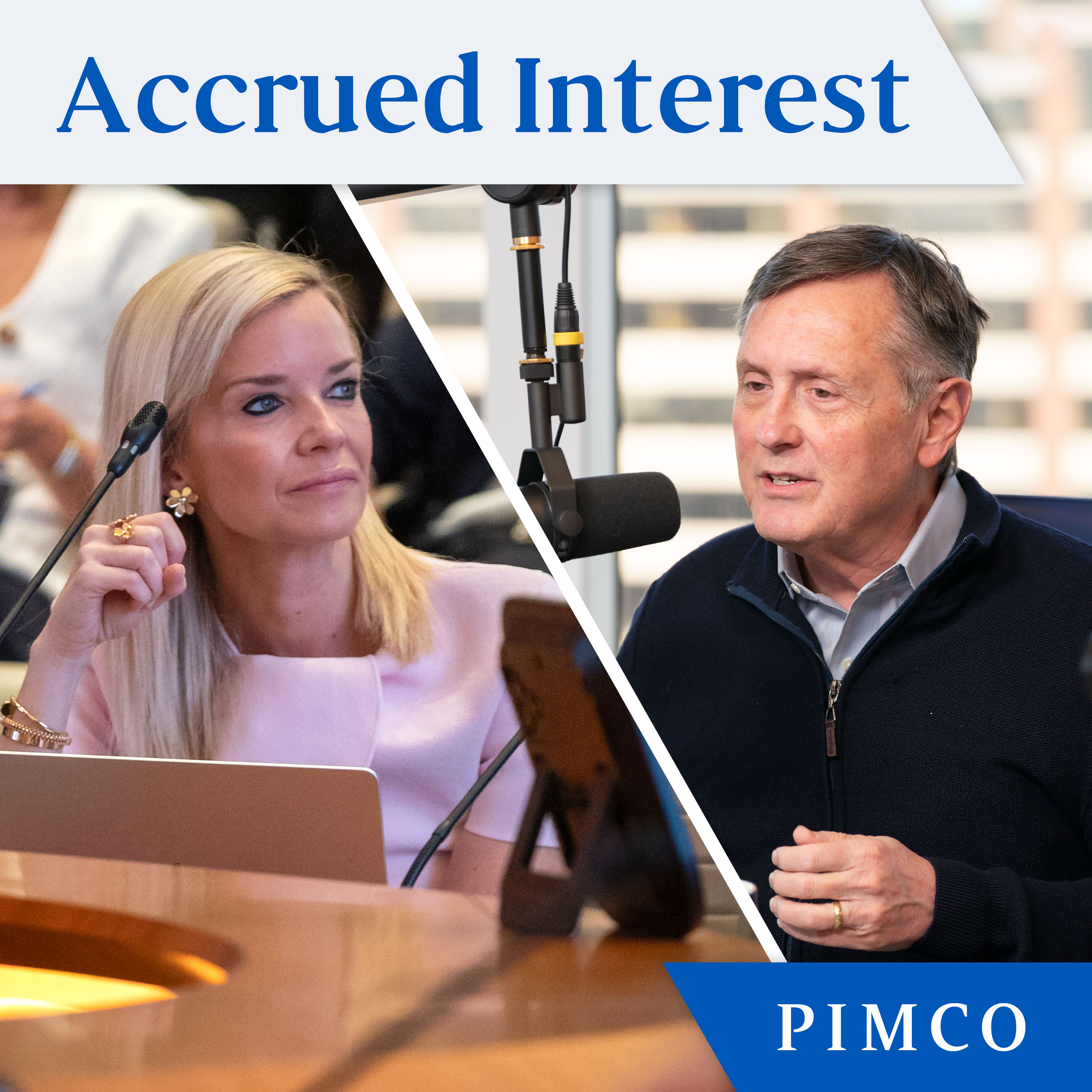
GREG HALL: Hey, everybody! Welcome to another episode of Accrued Interest PIMCO's podcast dedicated to serving financial advisors and their clients. I'm really excited today. We've got a heavy hitting session. I've got Rich Clarida, our Global Economic Advisor, former Vice Chair of the Federal Reserve, current professor at Columbia University, sitting across the table from me. Hey, Rich, thanks for joining us.
RICH CLARIDA: Glad to be back.
GREG HALL: And because today's conversation's gonna span both fed and monetary policy, and we're definitely gonna get into politics, I'm so lucky to have Libby Cantrill, who's our head of Public Policy at PIMCO. Libby, thanks for joining us today!
LIBBY CANTRILL: Thanks for having me. Also, nice feedback.
GREG HALL: This is an episode that we have been waiting to do, Rich, because we said to ourselves, we gotta have Rich back on the pod. He does such a great job, but let's wait till we get the confirmation of the new Fed chair.
And I'm not gonna lie, there were a few moments over the course of the last few months where I was worried we wouldn't get this done, this year. But, but maybe surprising folks, is that more or less on time, we've had an orderly transition of Fed leadership. So maybe, why don't we kick off there and tell us about Kevin Warsh and what you think of the confirmation and where we go from here in a Warsh Fed.
RICH CLARIDA: Yeah. So Kevin Warsh is very impressive. He has experience as a policymaker. He was the youngest ever Fed governor back in 2006, he left the Fed in 2010, since then has been at the Hoover Institution out in Stanford, and also advising the legendary investor, Stan Druckenmiller, and importantly for our conversation, he's been a consistent critic of the Fed in monetary policy, almost from the day that he left the Fed.
So Kevin has a very long paper trail. He's ambitious, he's thoughtful and he definitely has some pretty strong ideas about how he would like to change the institution. In fact, he sometimes uses the term regime change when he anticipates what he'd like to do with the Fed.
GREG HALL: What are some of those ideas? What should we expect?
RICH CLARIDA: Kevin, truly made three criticisms of the Fed that over time he may wanna address. One, he's never been a fan of the big balance sheet of quantitative easing, and he's been very consistent on that. Secondly, to be blunt, he thinks Fed officials talk too much, that they rely too much on forward guidance and that less may be more when it comes to Fed communication.
And thirdly, he, and here, Kevin's been consistent. He's been critical of Ben Bernanke, Janet Yellen, Jay Powell. He thinks the Fed has become too discretionary and does not conduct policy according to a compass, say, according to a policy rule like a Taylor type rule.
So let's go through each of these. In turn, making a decision on the balance sheet is a committee decision. It's gonna require an affirmative vote of the open market committee, just like it will be to cut rates or to raise interest rates.
Secondly, there's not really much he can do about Fed communication in the sense that reserve bank presidents and governors are gonna give speeches and go on CNBC. He may be able to have an influence over things like the economic projections or the dots. And then when it comes to rules-based policy, the Fed already publishes twice a year its policy decision relative to policy rules.
So it's not clear what addition he would do there. But I think the key point I want our listeners to understand is that even though folks including myself, tend to personalize the Fed in the person of the chair, so the Bernanke Fed or the Powell Fed, Greenspan Fed, really, the Fed is a committee. And by statute, any material decision is gonna require an affirmative vote. And so ultimately the power of the Fed chair is the power of persuasion.
GREG HALL: Yeah. You've been really consistent with us on that topic. Just reminding us the chair is one vote, and obviously he inherits a whole group of governors and actually steps in at a time in the most recent Fed meeting. And keep me honest on this one, but I think it was the most dissent we've seen 8-4 vote on the last rate decision. So just talk about that as a backdrop for him stepping in and what he, what you think he's gonna focus, what he's gonna contend with some of his other members.
RICH CLARIDA: Yeah. So I think the most recent meeting illustrates well, the committee that Kevin Warsh is going to inherit. And it's a committee of capable, thoughtful people, but for the most part, especially given the hostilities in the Middle East and given frankly, some pretty bad inflation data even before the hostilities commenced, it's a committee that's very much in wait and see mode.
Three of the four dissents at the last meeting were a bit unusual in the sense that they were not dissents over the policy decision. They were dissent over the language in the decision. And the folks who voted against felt that the existing communication implies that the next move, whenever it happens, will be a cut.
And they would've liked a more neutral bias to the statement. There was a dissent in the other direction to cut rates that was now departed, or I guess as of Friday departed governor Stephen Miran, because Kevin Warsh will take his slot on the board when he is sworn in on Friday.
GREG HALL: Libby, just to get you in on the conversation here, one of the things I'm sort of curious about is now with Warsh having or being about to sort of formally step into the role, are we out of the woods on the Fed Independence debate? Or does that ensue and kind of continue into the Warsh Fed?
LIBBY CANTRILL: Yeah, I mean, this, I think for a while, has been one of the top questions that our clients have been asking us, particularly our foreign clients who maybe have a little bit less access to kind of the understandings of the Fed. I think our view, one has been that maybe concerns over Fed independence have been a bit overstated just given what Rich said, given that the Fed chair in particular is just of course one of 12 votes, I would also point out that there are other guardrails that protect the Fed from being too influenced by politics.
Another kind of process point is that the Senate confirmation is incredibly important, I think, as we have seen, and that is yet in kinda another check, and to the President, but also to ensure Fed independence. And then also the Supreme Court, which has been pretty clear and we'll see, the Lisa Cook decision has not, that verdict has not yet been rendered, but what they have said, and oral arguments suggests…
GREG HALL: Lisa Cook is the governor. Who was investigated, it was the mortgage
LIBBY CANTRILL: Right. So, yes. And just to be clear, Lisa Cook is a sitting Fed governor. She's one of seven. The president has tried to fire her because of the alleged mortgage fraud. This case went to the Supreme Court. And again, they have not rendered a verdict yet on it. But just from oral arguments, it looks like they're likely to sympathize with, with her and not with the president.
And I think just to take, to step back, this President has definitely pushed the norms in terms of sort of, demagoguing, the Fed rhetorically kind of pushing back on the Fed.
I may argue though, that this is a pretty modern convention, that this idea that the President doesn't necessarily kind of attack the Fed in public has become a norm really in the last 25 years.
LIBBY CANTRILL: And if you go back, of course, to President Nixon and Chairman Alfred Burns of the fed, that's when there was quite a lot of tension.
But actually, if you go back even further and you go back to LBJ, and William McChesney Martin, who was the current fed chair, you actually saw some physical violence.
GREG HALL: Oh, gosh.
LIBBY CANTRILL: Or at least some physical prodding. Where you actually had LBJ allegedly pushing the chairman to the wall and arguing that he needed to raise, excuse me, to lower rates, because of the Vietnam War. So, again, I think the point just stands that there is always going to be some natural tension between the Hhite House and the fed chair.
And so, just to underscore this view that we've had that we believe that sort of concerns around fed independence have been a little bit overblown and that there are several guardrails that ensure that the fed is actually making decisions based on data and not politics.
GREG HALL: Well, that's definitely a good perspective. And I guess we'll, we'll hope it doesn't come to physical violence. Yeah.
LIBBY CANTRILL: But I do think now with the successful confirmation of Kevin Warsh and sort of proceeding forward, I think that this sort of, this issue of fund independence probably at least has been sort of tabled in terms of sort of one of the top questions in our client's minds.
GREG HALL: And, hopefully no fistfights.
LIBBY CANTRILL: And hopefully no fist fights. Exactly!
GREG HALL: Do you guys think that, so, it, I think maybe a year ago when we started talking about this as Powell's term was coming up, sort of felt like whoever came in and Fed chair would have a bias toward cutting, just by virtue of sort of the process and who was put forward.
I wonder if you think that bias sort of continues with Warsh, and then it sounds to me, Rich, just reading between the lines that you feel like the balanced view, the wait and see view will probably win out when it comes to a vote. But how do you see that tension sort of playing out over the course of the year between wanting to cut and support maybe a political agenda versus maintaining a stricter monetary policy?
RICH CLARIDA: Yeah, I think a couple of things are relevant here. You know, because this process played out over a long period of time, the initial conditions that Warsh will inherit, I guess he's being sworn in on Friday will be a lot different than they would've been back in January.
So just several months ago before hostilities commenced in the Middle East and global oil markets were thrown into to turmoil the story, the Fed's view, and really PIMCO and the market's view of the economy is that the worst of the post tariff inflation surge was probably in the rear view mirror, that inflation would drift back down, if not to 2%, then into the low twos and two, and Fed officials, or at least a majority thought coming into the year that they would be cutting twice this year.
And so, that would've been an environment in which Kevin Warsh probably could have persuaded at least six other people to support a rate cut. Now you fast forward to what he will inherit, inflation is close to 4%. We may not have seen the worst from the oil shock and higher energy prices. Moreover, as I mentioned earlier, the data that we got for inflation in December, January and February, even before the Middle East war, was moving in the wrong direction.
You have other central banks that may be hiking, in particular the ECB, the Bank of England. And so I think given that circumstance, the best Warsh can probably do for the remainder of this year is just to keep the committee on hold. I think he'll try to make a case if energy prices mean revert and we get into normalization.
He'll try to make a case in 2027 that some additional rate cuts are warranted. But right now, I think the path of least resistance for him will be just to preside over a wait and see period.
GREG HALL: Yeah. I guess, you've mentioned it a couple of times, but obviously the hostilities in Iran and that region loom large here, and kind of any calculation of what's gonna happen, Libby, what, where do we stand? Sorry to ask you the tough question.
LIBBY CANTRILL: Yeah. No, I think we should probably timestamp this because it, I mean, it is incredibly fluid, the Presidents…
GREG HALL: That is a very good idea. This is Wednesday morning, the 20th. You know, at 11:00 AM
LIBBY CANTRILL: Yeah. Because I mean, really it is that dynamic. I was just on a plane last night without wifi, and of course, you land and you just wonder what are the headlines going to bring, I mean, I think, obviously right now, the Strait of Hormuz is effectively closed. Negotiations are ongoing. And I think for the President, there's sort of three different scenarios, or three different kinda options, if you will.
One is to basically declare victory on this. And to try to retreat and pivot to the midterm elections and to sort as domestic policy agenda that I think is just increasingly more difficult, because I think strategically there will be some questions about what the US achieved.
I think it's probably gonna be relatively unacceptable to our allies in the Gulf, particularly to Israel if the Iranians sort of set up this kind of tolling of cargo through the street.
So I think that even though the President may wanna declare victory and go home and pivot away from this issue, I think it's gonna be very difficult for him to do that. The other, of course, is that this is sort of this frozen conflict, a little bit like what we have in Russia and Ukraine, where you sort of see some escalation. But for all intents and purposes, the Strait is basically closed.
I think that's also gonna be difficult for the President to accept. And then you also have, I think the sort of third option or scenario which is this kind of escalate to deescalate. And again, I don't think this is an attractive option either for the President, but I also think it is increasingly likely. For every day that kind of goes on without a resolution.
And that will look like more targeted bombing, more bombing of infrastructure. And then probably trying to sort of force the Strait to remain open, or to open up. So I think kind of the bottom line here is that, you know, the President had, I think arguably and objectively a lot of success with the Venezuela mission. I think there was probably some confidence from that.
And I think that probably some miscalculation about just the complexity of this Iranian situation. And of course, now we're here though, and there's these three scenarios or options, all of which are really not that attractive to President Trump.
GREG HALL: When you talk to our, the security experts who are part of our global advisory board and any number of your contacts in DC I mean, how do you think about the enormity of the job of escalating to deescalate and punching through to the other side?
LIBBY CANTRILL: Yeah, and of course, I mean, I think that it really depends on what that means. If that means troops on the ground potentially could mean that probably he'll have to go to Congress for either a direct authorization for that and or for more money. I mean, remember, this is what I mean, I think our colleagues are always tired, exhausted of my, you know, reminding folks.
But Congress has the power of the purse, right? And while the Pentagon is well funded through the One Big Beautiful Bill, which allocated an extra $150 billion for it, this conflict is expensive. And so ultimately the President will have to go to Congress regardless, but if he were to actually send troops in the ground, he probably will need both for the money, but also for the authorization. So that's gonna be an obstacle.
And then I think also politically, and of course that's the lens that I, through which, you know, I think the market now looks through a lot of these things. This is a very unpopular conflict. It was very unpopular to begin with, you know, a majority of Americans disapproved. It has become increasingly unpopular.
So I think that there are a lot of obstacles. I'm not trying to say this is going to be kind of a neat resolution, but I think increasingly as, again, the days go by without a resolution, it just becomes more likely that this is gonna be something that he at least has to really seriously consider.
GREG HALL: Rich, what are markets telling us about how they think this will all unfold over time? As you look at forward curves and what's priced into different areas of commodities or rates?
RICH CLARIDA: It's been a very unusual market dynamic, at least in my perspective. Very much risk on equity markets. Equity markets hitting all time highs, credit spreads are tight. Yes, the Mag seven and excitement about AI is an element of that, but earnings were very strong in markets more than recovered any sell off after hostilities began.
The dollar traded up appreciated not enormously, but the dollars on balance been stronger. Perhaps the view being that yes, it's a global supply shock, but the US is energy independent and so that I think has been a factor in the markets. First and foremost at PIMCO, of course, we look at the bond market and the bond market reaction has really featured a pretty big sell off in rates now, importantly, for a variety of reasons.
Advanced economy bond yields going into March 1st, February 28th we're actually trending down. And so a lot of the sell off in terms of basis point increase looks much less if you compare it to the beginning of the year. But we've seen a sell off in rates globally.
Interestingly enough in the US not really based on expectations of much higher inflation. Now near term inflation, obviously markets are priced in that will have a pass through to gas and prices. But longer term, say inflation, five years out through the inflation index market has not really moved up very much at all. And so it's been a move in real rates and to some extent in term premium. And so, that I think is reflecting a couple of things.
One is the countries that have been hit hardest in the sell off are the ones that are importing a lot of energy. So that makes sense. Also, without naming particular countries, there are some that have credibility issues with regard to their fiscal policy, and those have been hit pretty hard as well. The final thing I'll say on rates is really for now three years.
You know, at PIMCO we started talking about a trading range for 10 year treasuries back in the summer of 2023, which turned out to be the last Fed hike in that cycle. And really since then, the 10 year has been in a range at roughly 5% at the high end and three and three quarters at the low end. And we're still in that range for the 10-year.
GREG HALL: Yeah. Just Professor Clarida, if you don't mind, I just wanna make sure for folks listening, I think it's really interesting what you were saying about long-term inflation expectations.
So actually as we, I'm not sure exactly how they sample that, whether it's through survey data or what's embedded in the difference between certain securities in the marketplace. Those haven't moved. So actually market participants expect us to maintain, kind of the course that we'd originally expected kind of coming into this year.
RICH CLARIDA: Yeah, that's actually quite important. And we discussed it at length in our secular forum last week. There are always gonna be shocks in the world. Supply shocks happen, demand shocks happen.
And so successful monetary policy is really not measured against, is inflation always equal to target? Is policy sufficiently credible? So that expected inflation, say five years in the future is consistent with the target. And that's really what we're seeing. And so that's actually quite important. Now, there are also surveys and with surveys of inflation, it depends on who you ask.
If you ask professional forecasters or bond market traders, they more or less just write down whatever the Fed's inflation target is. But of course, most people aren't bond traders or Fed officials. And so if you do surveys of the general public they're very sensitive to gasoline prices.
And it's a well known phenomenon that as folks drive to and from work every day, if they see the gas is $5 a gallon and not three $3.50 a gallon, that ratchets up their expectations.
GREG HALL: Big numbers on inflation and everything.
RICH CLARIDA: So we're seeing that in the survey data now.
LIBBY CANTRILL: Can I please clarify on that. I think this is actually an excellent political point as well. I mean, there's sort of this axiom in politics that it's sort of like gas and groceries, that the price of a gallon of gas, the price of a gallon of milk really matters to voters. I would also probably put now rents and housing and also healthcare.
But people are really sensitive to this. Even if they're not driving, they're very sensitive to this because again, as Rich said, they see this on a very frequent basis. There has been some discussion about the President and potentially the Republican Congress trying to push for a gas tax holiday. This is sort of the federal gas tax, 18.40 cents per gallon that folks pay when they go and fill up their car the tanks or gas tanks.
I think it's very unlikely that this happens. And I think this is also more, kind of a bigger, broader statement that there's just very little that the President can do unilaterally without the Congress to actually address these affordability concerns going into the midterms.
And, I think while President Trump has tried to do some things again that he can unilaterally again, you need Congress power of the purse to do things like suspend the federal gas tax. We've never actually seen this happen. I was at the Unicorn Capitol Hill.
People like to talk about a gas tax holiday, but actually it's, we've never seen it since 1993 when the federal gas tax was administered the way it is now. And as a result, I think it's very unlikely we see any sort of fiscal going into the midterms.
GREG HALL: Well, yeah, it's a good reminder. All of this is playing out with the midterms as an impending backdrop, and there's a lot of really thorny political problems for the President heading into that contest. Although he's demonstrating some political clout in primaries. So what do you think, Libby, I mean, how do the midterms shape what we're gonna see over the next few months and venture any revised predictions about what we see come November?
LIBBY CANTRILL: Well, I mean, look, I think, again, timestamping this, you know, May 20th, it is important to timestamp because I think folks understandably, are inclined to sort of extrapolate what is happening today and sort of push that forward in this case, five and a half months or what have you to the midterms and sort of make some high conviction and predictions.
Yeah, if you go back to 2022, everyone was talking about how there was gonna be a Republican wave in the spring of 2022. The generic ballot enthusiasm, all of those sort of indicators were pointing to a wave of election, and that didn't happen, right. Republicans, yes, they did take back the house, but they actually only took back the house by a pretty small majority. And then actually Democrats picked up a seat in the Senate.
So I just think it's just important to kind of bear in mind that while, yes, there are a lot of challenges for the President right now, and there are people who are discussing and talking about both chambers of Congress flipping, I still think it is too early to have any sort of high conviction.
With that said, I will give you my speculation at this point, I mean, look if you go back to the history, the party out of power almost always picks up seats in the house. I always joke that voters are dating politicians, they're not marrying them. Meaning that oftentimes they'll vote them in office and then one election cycle later, they'll vote them out. And I think that this cycle probably is not gonna be too different.
I think Democrats are opposed to probably do at least well enough in the house to pick up the three seats that they would need in order to take back the majority of redistricting, I do think has, kind of scrambled the chess board a little bit, meaning that there are fewer competitive districts, and that probably means that Democrats have a harder time picking up the house.
But again, if the current environment at least sort of maintains or looks somewhat similar in November, probably a good chance that Democrats can pick up those three seats that they would need to take back to the house. The Senate, though I'm really unconvinced that Republicans lose the Senate right now, Republicans have a four seat majority.
Democrats are defending some states that are not necessarily totally straightforward in places like Michigan and Georgia, but then they'd also have to win four of six Senate seats in places like Texas and Alaska and Iowa. It's not impossible, but if I would have to characterize it, at least as of today, I would say Democrats have to have like a mediocre to goodnight to take back the house.
They have to have a perfect night to take back the Senate. And I think that some indicators are suggesting a wave of elections, some are not, but I would just suggest in general, probably too early to have high conviction, kind of either way.
GREG HALL: Rich mentioned that certain countries whose fiscal policy lacks credibility might be facing some pressure in their bond markets, and I wonder how close we are to considering our own country as maybe lacking in fiscal credibility and to what extent both of you sort of see that maybe showing up at the long end of the yield curve or expressing itself in policy today.
RICH CLARIDA: So Libby and I talk about this a lot. We talk about it a lot at the firm. And there are always scenarios and we spend a lot of time looking at the scenarios. I think it's fair to say our baseline scenario. So the most likely outcome, although certainly not a slam dunk, is really kicking the can down the road.
Washington's not very good at very much, but as we've learned from Libby, they are good at kicking the can down the road, and so, the US is on an unsustainable fiscal path, so at some point in our lifetime, Congress and the White House will have to get their act together. But we don't see that as being imminent over the next five years. Oftentimes I'm asked by clients, well shouldn't that show up in interest rates?
And in our view is that, it is in interest rates. As the fiscal news is much worse than it was 10 years ago. Bond yields are higher term, premium are higher, real interest rates are higher. And so our view is that there is bad fiscal outlook for the US, but it's basically in the price, right now.
During my time at the Fed, 10-year treasury yields barely got above 3%, and they spent a lot of time in, around 2%, and they're now in the mid fours. And so our view is eventually there will be fiscal day of reckoning, but it doesn't look to be imminent. And one reason why the treasury curve is steeper and yields are higher, is that investors are getting compensated now for that fiscal outlook.
GREG HALL: Right. And that's the term premium you spoke of earlier, right. That's what that term means. Pardon the pun term.
LIBBY CANTRILL: Yeah, I mean, I would, I was chuckling before because I mean, I do, I mean, obviously, across the G-7 particular, I mean the debt to GDP ratios are just incredibly high. Actually, the US looks on a relative basis, actually much better than obviously Japan and France and Italy and what have you. And I think importantly that there are tools, should policymakers need to use them, if they're foresighted by the market or what have you in order to improve the deficit situation.
One of course is raising taxes. We just have a much lower tax base here in the US than across the G-7 meaning we have theoretically more flexibility. Of course, politicians don't like raising taxes on either side of the aisle. I would just say, I think this is actually the, sort of the new development over the last 15 years or so, is that you've seen this economic populism sort of seep into both sides of the aisle.
And as a result, now both parties like to spend, and neither party likes to actually raise taxes, but theoretically, if push comes to shove, they could. And then we've also talked about some milestone that seems to be kind of far off in the future, but it's becoming closer, which is when the Social Security Trust fund kind of goes bankrupt, so to speak.
It just basically means that social security has to cut benefits, it's taking in less than it's sort of paying out. That means that they actually have to then cut benefits. Members of Congress will not let that stand. And so that could also be an inflection point. So I think that and then of course you add on just the growth dynamics in the US productivity, this culture of innovation, you know, immigration, labor, mobility.
I mean, the US just has sort of better ingredients in order to, if kind of when push comes to shove and there is this sort of fiscal reckoning to sort of do the things and to kinda look better than across the G-7. But I think the bottom line is, as Rich eloquently said policymakers really have no appetite to do something unless they have to.
I always say, as long as the music is playing, members of Congress will keep on dancing, and as of now, the music continues to play. So yeah, they'll just kick this can down for another day.
GREG HALL: Let me, I, so as we think about the economy, maybe in the near term, we had Marc Seidner and Pramol Dhawan on the previous episode, which was just released. And we were talking about shockingly for PIMCO, we were talking about the bond market and macro. And Marc you know, Marc coined this little turn of phrase that I thought was funny.
We were talking about stagflation and he said, I'm a lot more worried about the stag than I am the flation, right now. And I want to make sure advisors listening really understand this tension that's going on right now, which is obviously the energy shock has a first order effect of pushing up prices, but it also serves as a break on the economy.
Rich, which force do you think ultimately has more power and, are you more worried about the stag or the flation to use Marc's clever turn of phrase?
RICH CLARIDA: Yeah, so let's define terms. So stagflation, I think most simply is a period where you've got higher prices, so higher inflation but you have higher unemployment. I think for most people, they don't, they think of employment as opposed to GDP growth. You can also do slower GDP growth. And, I was in college in the 1970s and so that was the decade of stagflation. There were three recessions.
Inflation was 10, 14, 18%. The unemployment rate got up to 11%. And so I'm always a little bit careful to use that term 'cause I like to reserve it for those situations, where you're really at double digits in both. But I think it's fair to say that the nature of this energy shock has a whiff of stagflation in it, in the sense that it's going to push up prices.
And because it erodes real incomes and an important point that we talk about a lot here at PIMCO Greg, is this idea of a K shape economy, and for a substantial percentage of the economy are basically living paycheck to paycheck. When the price of gas goes up from $3 a gallon to five, or in California I was out $7 a gallon.
That's money you don't have to spend on something else. And so it does tend to slow the economy. Another, of course, driver of the economy right now is the fact that, and this is more or less unique to the US, is we have such strong demand in capital spending with the build out of data centers and the tech sector more generally.
And so whatever stag we would see in the stagflation otherwise may be attenuated simply because of the dynamics in the economy from the data center build up.
I do think it's important, however, for the monetary policy call, so long as we're in a period where you're seeing the inflation part of stagflation, but economic growth is holding up and employment is holding up, the Fed could be on hold for a long time.
If you actually do start to see the stag and you do start to see the labor market crack,that probably will shift a lot of thinking on the Fed about the policy response. But right now we're just basically seeing the inflation part of the stagflation, but it's early days.
We're not gonna get second quarter GDP growth until the end of July, for example, and the energy shock really just hit in March. And so it's too really too soon to tell how that's gonna show up in the data.
LIBBY CANTRILL: Let me, sorry, if I can just ask again on this sort of this gas point, because I think it is an incredibly relevant one. I mean, if you go back to January, and our view was that the economy was going to see solid growth in 2026, partly because of the AI, you know, CapEx related build out, but also because of the One Big Beautiful Bill.
If you remember, this was obviously passed back in July, so it feels like it's in the rear view mirror, but it was effectively two years of tax cuts kind of shoved in one year in 2026. So this was supposed to be, if you're a member of Congress, you wanna go back to your district and talk about these great refunds that you're getting, you now have higher take home pay because withholding is lower. And of course that is still true that is working its way through the economy.
We're seeing refunds maybe come in a little bit lower than expected, but still, you know, higher than they were certainly in 2025. However, those refunds, particularly for this kind of lower shaped, you know, K or the sort of two speed economy folks at the sort of the lower to middle income cohorts that refund is really been quickly eaten up by higher gas prices.
And so, if you just think these folks were already a little bit vulnerable coming into 2026, that this was supposed to, the One Big Beautiful Bill was supposed to broaden out consumption and was supposed to sort of shore up their own kind of household balance sheets and that unfortunately it's not completely reversed, but you're just as, again, as this conflict wears on as gas prices stay elevated, and I think our view is that even if you have the Strait of Hormuz open tomorrow, you're still gonna see disruption in the oil market, which means that gas prices will still stay high, that kind of, again, that support for those cohorts is gonna quickly gonna be into by higher gas prices.
GREG HALL: Yeah, and that's a great point. So the One Big Beautiful Bill act overshadowed by the conflict in Iran and possibly overwhelmed from a fiscal impulse…
LIBBY CANTRILL: Potentially. Yeah, exactly.
GREG HALL: …standpoint. The other thing, Libby, that we haven't been talking about a lot recently, but still lingers in the background, is tariffs,
LIBBY CANTRILL: Right. Yeah, I know. Again, I think that feels like it's rear view, but really is not. And I think there's been so many kind of conflicting headlines that I think, understandably, our clients have been confused. I think the markets have sort of been confused about where things stand.
But as a reminder, when we came into this year, the effective average tariff rate was around kind of 13 to 14%. And that was a collection of other tariff policy actions that the President had taken over 2025. Now, of course, the Supreme Court earlier this year in 2026 over turned the IEEPA tariffs, this international emergency economic powers, that kind of a mouthful, but that was more or less more than half of the tariffs that were put on. So that means that those tariffs rolled back around, sort of 7% average defective tariff rate.
It also means that the treasury now has to pay back those tariffs they collected. That's kinda interesting. I'm still waiting for my tariff refund. I have not gotten that. I think it's going to DHL unfortunately, I think that we'll have a long tail actually of those paying out those refunds.
But I think this is the most important point, is that even though the Supreme Court has sort of denied the President from using this one tool, he has a lot of other tools, they're more cumbersome, as he has sort of said they require investigations than public comment and what have you.
But I think that the direction of travel continues to be clear on tariffs, that as long as this President is in the White House, we will see higher tariffs. And I would argue because of the deficit situation, those tariffs are pretty sticky and will probably continue kind of, regardless of who wins in 2028…
GREG HALL: And ideologically, the President simply does not view tariffs as attacks on Americans. And so, any impulse to say, maybe not fight as hard to lessen the burden on folks from an affordability standpoint, you don't see that happening. He just doesn't agree with the premise, right?
LIBBY CANTRILL: He exactly, he believes tariffs are a solution and not a problem. He truly believes that other countries pay for the tariffs. I think that that is just, again, just to underscore this, that if you just look at that K-shaped economy, these folks now higher gas prices, they've also been hit by higher healthcare prices because the affordable, the enhanced premiums of the Affordable Care Act expired at the end of this last year.
And tariffs, I mean, this is just a kind of an ugly policy mix for these groups of people and so how does that play out politically? Of course, we'll have to see. But it will certainly be a challenge going into the midterms.
GREG HALL: Maybe we will end on a longer term, maybe even more optimistic, but really curious. So we talked about sort of the short term crosswinds in the economy, but obviously the stock market's hitting new highs each day, and there's a lot of enthusiasm and optimism about AI and tech spend. Rich, as we look out 5, 10, 15 years.
Do we share in that optimism? Do we think that equity markets maybe know something that the bond markets don't right now? How are we thinking about that trade off?
RICH CLARIDA: Well, I think it's clear. We began discussing AI at PIMCO months after ChatGPT was introduced. And I went back and read my notes of our initial discussions and compared them to the discussion we had last week at secular. And it's truly striking how rapidly the models have evolved, improved.
And so, whereas three years ago, it was sort of like one scenario, hypothetical, we're absolutely in the camp that this is a transformative technology and that at some point it will begin to show up in productivity data.
So I think that's gone from one scenario to probably the baseline now, but there are still a number of important questions that are relevant to the economy and to the bond markets. One is that it's clear that in order to get the benefit of a higher productivity, there needs to be a lot of capital investment now.
And so there needs to be an increase in demand for concrete and computer servers and construction workers now to get that productivity increase. Just one fun fact I'll share with you. I did television a couple weeks ago and I got, I was asked a similar question by the moderator, and I mentioned that, you know, data centers are both the very best of the 21st century and the 20th because you need computer servers and Nvidia chips, but you also need Caterpillar tractors and construction workers in our live television.
She goes, Caterpillar's a $900 stock. And I must admit, being a PIMCO, I didn't know what the price of Caterpillar was, but so there is that element. And so, the real question is at what point does this then evolve and do boosting productivity?
Probably the most important question though is even if you stipulate the productivity increase, the real question, and we don't have a crystal ball in one of the disciplines inside PIMCO is to try to not be overconfident when you don’t have an edge.
But it's really very uncertain now among different experts. Whether or not AI is going to look like past transformative technologies in which you got both the benefit of the technology, but you got to maintain a high level of employment or whether or not this time is different. And we're looking at tens and 20 million job losses eventually from this.
And we don't think that's imminent. We think we may be a ways or we may never see that, but there's a huge amount of uncertainty. The further out you go about both how much of a productivity boost you get and what are the employment consequences.
LIBBY CANTRILL: And politically, this is again. I'm sorry, not gonna go back to that. But I mean, politically, I do think this is a challenge for policy makers because there is just a lot of fear in this country. And if you actually look at Pew Research released a poll two months ago, and it was quite interesting because Americans are actually the most pessimistic about AI relative to other countries, including Europeans which are usually very kinda pessimistic about, or any technological innovation with all due respect to our European colleagues and clients, of course.
So, I do think though, but it does speak to this fear, this uncertainty, not only that, about jobs, potential job losses, which of course we have not seen yet, but also rising costs, right? You do see that in these localities that are, have data centers in them that electricity costs are higher.
And so this again, is just, I think, described as sort of a boogeyman, that even though it may not actually be at fault for very much, people are want to blame something, and it's a pretty easy kind of narrative to latch onto.
GREG HALL: Well, I tried to end on a positive note. Yeah, well, no, I was gonna say, as bond investors, I suppose it's always good to be thinking about, about downside and approach the world with a critical lens. So anyways, thank you both for joining us. Thank you for spending as much time as you do with our clients all around the world and helping them think through all of these complex topics.
If you've enjoyed today's conversation, we would really encourage you to visit pimco.com in the US or your local country's website. If you declare yourself as a financial advisor, you'll be taken to Advisor Forum. That is our one stop shop for you to access everything you need from PIMCO as quickly and efficiently as possible so you can get back out on the road visiting with your clients and helping them think through these very uncertain and tricky markets.
Please don't be shy, like, and subscribe to the podcast so we know you're there. That helps us bring you more great content like this, and we will see you next time.
From This Episode
Together with host Greg Hall, they explore the next chapter for the Federal Reserve under Kevin Warsh, the fluidity of the conflict in the Middle East, and the political ripple effects of AI, inflation, and tariffs.
About the Speakers:
- Dr. Richard Clarida is a former Vice Chairman of the Federal Reserve and current Global Economic Advisor at PIMCO
- Libby Cantrill is a Managing Director and Head of Public Policy for PIMCO
- Greg Hall is the host of Accrued Interest, a Managing Director, and the Head of U.S. Global Wealth Management for PIMCO
[1:09] What to expect from a Warsh-led Fed
[11:09] The fluid nature of the conflict in the Middle East
[15:46] The political ripple effect of inflation
[22:45] How do the midterms shape the rest of 2026?
[25:11] Fiscal credibility and the bond market
[29:37] Is stagflation really in play?
[35:16] Where do things stand with tariffs?
[38:02] The state of AI optimism
If you enjoyed the episode, check out our related resources below:
- A New Fed Chair, a New Tone – But Familiar Anchors by Richard Clarida
- Podcast: When Geopolitics Becomes an Economic Input
Subscribe to Libby Cantrill's newsletter, Washington Watch.


